Biotechnology and pharmaceutical companies often rely on standard products for biomolecule purification and immobilization. However, when higher performance, improved efficiency, or project-specific adaptations are required, standard solutions may no longer be sufficient. In such cases, customized resins become essential, enabling processes to meet unique requirements while surpassing conventional results.
At Agarose Bead Technologies (ABT), one of their hallmarks over the past 25 years has been providing customized services in close collaboration with our partners, ensuring that their projects are not only feasible but also stand out in terms of process efficiency, cost-effectiveness, and quality.
CUSTOMIZATION APPROACH
Custom resin development requires close collaboration between manufacturer and customer. The process typically follows four key phases, from initial discussions to full-scale manufacturing under stringent quality standards.
Phase 1: Project starts (1h)
Phase 2: Evaluation of the viability (1-2 weeks)
Phase 3: Project starts (4-6 weeks)
Phase 4: Evaluation of the viability (3-6 months)
CASE STUDY: A HIGH-CAPACITY AND ALKALI-RESISTANT PROTEIN A AGAROSE RESIN
In response to a customer’s demand for a Protein A resin that combined exceptional binding capacity with enhanced resistance to sodium hydroxide (NaOH) during cleaning-in-place (CIP) procedures, our team developed a custom-engineered solution using a Design of Experiments (DoE) strategy.
This systematic approach allowed the simultaneous optimization of three critical parameters:
The resulting prototype exhibited a significantly higher Dynamic Binding Capacity (DBC), even at reduced residence times, while preserving excellent alkaline stability (Figure 2).
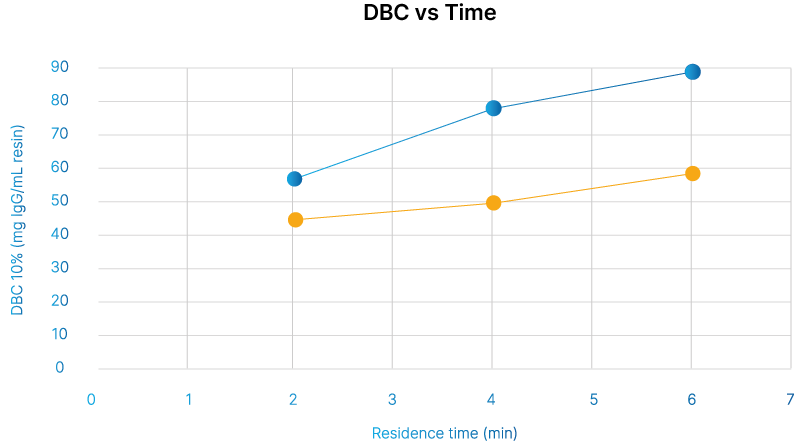
Figure 2. Comparison of DBC10 versus residence time between the customized prototype (blue) and a commercial benchmark resin (orange).
This outcome highlights how their customization service enables the joint development of tailored chromatographic solutions, working closely with customers to rapidly address specific process requirements and accelerate biopharmaceutical purification workflows.
Main Image: Adjustable parameters to meet specific requirements.

La mejor actitud que podemos adoptar es la de trat...

The research team observed changes in head circumf...
AtCDF3 gene induced greater production of sugars a...
En nuestro post hablamos sobre este interesante tipo de célula del...

Telum Therapeutics, a biotechnology company leveraging proprietary met...