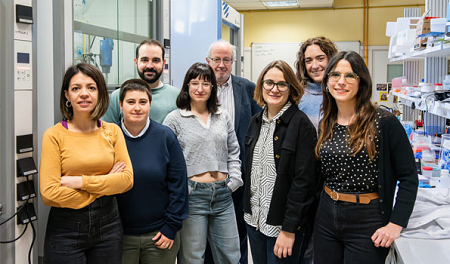
A team led by Ramón Martínez Máñez, a researcher at the Universitat Politècnica de València (UPV), has developed a pioneering nanoparticle capable of restoring communication between tumour cells and immune cells. This communication, which is often lost in tumours due to immune-evasion mechanisms, is key to the immune system detecting and eliminating cancer cells. The work opens up a new therapeutic approach in the field of nanoimmunotherapy.
The innovative nanoparticle is inspired by bispecific antibodies (BiTEs), a clinically approved tool for treating haematological tumours, but that has some drawbacks: a complex production process, a short lifespan in the body, limited efficacy in solid tumours and adverse side effects.
The Janus-type nanoparticles developed by the research group overcome these drawbacks: they are easy to produce, adaptable to different types of cancer, and have a longer lifespan in the body than BiTEs, allowing them to accumulate more effectively in tumours with a lower risk of side effects.
Experiments in melanoma
In in vitro cultures of human melanoma cells and immune cells (lymphocytes), these innovative nanoparticles, called J-pHLIP-PD1, have been shown to remain exposed on the membrane of tumour cells and to present their other side to lymphocytes. In this way, the nanoparticle mediates the interaction between the lymphocyte and the tumour cell, acting as a bridge that facilitates the death of the cancer cell.
Reduction of metastasis in mice
Its therapeutic potential has also been tested in a mouse metastasis model, a difficult-to-treat cancer, with very encouraging results: the nanoparticles have significantly reduced the formation of metastases in the animals' lungs. 'This superior efficacy can be attributed to their ability to restore communication between the immune system and the tumour, as a significant increase in cytotoxic lymphocytes was observed in the lungs of mice treated with the nanoparticles,' explains researcher Ramón Martínez Máñez.
Novel technology
The application of Janus-type nanoparticles in immunotherapy marks a step forward in innovation, as it enables different types of ligands to be precisely targeted to bind cells, something not possible with other nanoparticles.
"One side specifically recognises tumour cells – in this study, melanoma cells – and the other binds to immune cells. In this way, the nanoparticle acts as a bridge between the two, mimicking natural immune synapses and re-establishing communication between the two cell types," explains Alba García.
Applications and next steps
According to the research team, although the study has focused on metastatic melanoma, this technology could easily be adapted to other types of solid or haematological tumours. The team is already working on its validation for the treatment of more complex solid tumours, including triple-negative breast cancer, where physical barriers hinder access by the immune system and conventional immunotherapy has limited results.
'These nanoparticles are more stable and able to concentrate in tumour areas, and are expected to achieve good results in the most difficult tumours,' they explain. In addition, their porous core allows drugs to be loaded and different strategies to be combined in a single system.
The work has been published in the journal Advanced Materials and carried out by the Nanosens group at the IDM of the UPV, which is part of the UPV-CIPF and UPV-IIS La Fe joint units. The members of the research group are also part of CIBER-BBN.

La mejor actitud que podemos adoptar es la de trat...

The research team observed changes in head circumf...
AtCDF3 gene induced greater production of sugars a...
En nuestro post hablamos sobre este interesante tipo de célula del...

Telum Therapeutics, a biotechnology company leveraging proprietary met...