Our body’s organs like the intestines, lungs or skin, are covered by a layer comprising millions of interconnected cells that separate the inside of our body from the outside world. These layers, called epithelia, control processes essential for life such as the exchange of gases for respiration or the absorption of nutrients, while preventing the entry of harmful agents such as microorganisms and pollutants.
In order to ensure these barrier and selective exchange functions, the cells of the epithelial layers are constantly renewed. In some cases, such as the intestine, they do so at astonishing rates that lead to total renewal –of billions of cells– in 3-5 days.
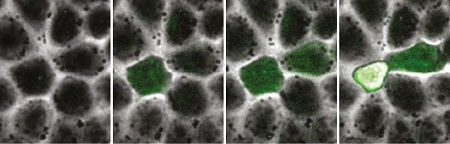
To maintain a balance in the body’s epithelia, cells use a method of controlled killing called extrusion, which is common from marine sponges to humans. Thus, when an epithelium is overcrowded, the leftover cells are expelled and die.
Repolarize or die
Hitherto, extrusion was known to be activated by mechanical forces derived from the accumulation of cells within the epithelial layer. But what caused one cell to die and its neighbours to survive remained a mystery. Now, the study published in Nature explains how mechanical forces activate an electrical sodium input current that depolarizes the membrane.
“Crowding causes the sodium channels of the epithelium to open, which leads to the entry of salts and the depolarization of the cells”, explains Rosenblatt, who led the research. “Strong cells can pump sodium outwards, which repolarizes. But weak ones that lack energy, cannot do so. They use a “last gasp” of energy to activate a current that causes water to flow out of the cells. In this way, they lose volume and facilitate extrusion”.
“This sodium channel acts as a sensor, exposing cells with less energy and selecting them for death. This mechanism provides the epithelium with a constant surveillance system to quickly detect weak cells and eliminate them. It’s like an electrical quality control, which keeps the tissues robust and functional”, adds Saranne Mitchell, of King’s College London.
“I find it particularly satisfying to see that the basic mechanisms that we learn in the first year at university –and I now explain in my classes– continue to serve for making new discoveries”, mentions Carlos Pardo-Pastor, a postdoctoral researcher at the UPF Molecular Physiology Laboratory. And he adds, “one day I was going over the same old thing for the umpteenth time when I the idea came to me that cells with little ATP –little energy– would have difficulty maintaining membrane potential, and that this should make it easier to trigger the electrical circuit that leads to extrusion”.
Beyond having energy or not
Extrusion is the main controlled cell death mechanism, so that new cells can grow and old and defective ones do not accumulate. As in tumours, when extrusion does not work, cells accumulate.
“Discovering that energy-deficient cells extrude more easily leads us to think about the role this mechanism can play in diseases with metabolic alterations”, highlights Jody Rosenblatt, the discoverer of the extrusion process who has been studying the alteration of the lung epithelium in asthma for some time.
“Seeing that extrusion is triggered in cells with low energy levels leads us to wonder whether excessive caloric intake could be cancelling out this “low energy” sensor and hindering the elimination of defective cells”, Pardo-Pastor reflects. “If so, hypercaloric diets could be promoting cancer by interfering with this cell death mechanism”.
Beyond tumour processes, this finding “could help explain how energy deprivation in vascular accidents can generate excessive extrusion that ends up damaging organs”, Pardo-Pastor observes.
Reference study: Mitchell, S.J., Pardo-Pastor, C., Tchoumakova, A., Zangle, T.A., Rosenblatt, J., 2025. Energy deficiency selects crowded live epithelial cells for extrusion. Nature. https://doi.org/10.1038/s41586-025-09514-w

La mejor actitud que podemos adoptar es la de trat...

The research team observed changes in head circumf...
AtCDF3 gene induced greater production of sugars a...
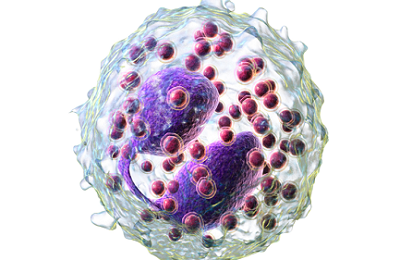
En nuestro post hablamos sobre este interesante tipo de célula del...

Telum Therapeutics, a biotechnology company leveraging proprietary met...