The FLAIR-GG federated network integrates germplasm data of wild species under the FAIR principles (Findable, Accessible, Interoperable and Reusable). Its objective is to facilitate access and use of these resources, promoting scientific collaboration and advances in biodiversity, agriculture and conservation.
Preserving plant genetic diversity is crucial for global food security, biodiversity, and environmental sustainability. Germplasm banks, which store seeds and other genetic materials, play a central role in this mission. However, the way information is managed and shared among these banks poses significant challenges. Databases used to store plant genetic resources (PGR) often lack standardization, operating with different formats and systems, which makes it difficult to access, integrate, and use the data effectively. This issue is particularly critical for wild species and crop wild relatives, which are key to enhancing biodiversity and developing resilient agricultural systems.
While there are global information systems like Genesys PGR and its European counterpart EURISCO, these platforms primarily focus on cultivated crops. This emphasis leaves a significant gap in addressing the needs of wild species germplasm collections. Wild species, including crop wild relatives, are essential for introducing genetic traits like drought resistance, pest tolerance, and climate adaptability into cultivated crops. Unfortunately, current databases often lack environmental data about where these plants were collected, information on their genetic uniqueness, or details about whether the accessions in different banks overlap. These gaps hinder effective collaboration and conservation efforts.
To overcome these challenges, we propose applying the FAIR Principles to germplasm data. The FAIR principles aim at improving data Findability, Accessibility, Interoperability, and Reusability. By following these principles, data from germplasm banks can be standardized, linked, and made easier to discover and use. This would ensure that researchers and conservationists can access and analyze information about plant genetic resources, saving time and resources by not having to solve incompatibilities caused by where the data is stored or in what format.
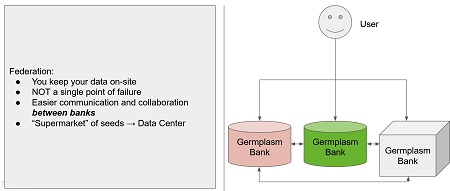
One of the key solutions presented is the creation of a federated network of germplasm databases, a system where different organizations or databases work together as part of a larger network while still maintaining their independence. Instead of storing all the data in one central location, each participant keeps its own data but agrees to share it in a standardized way that makes it accessible and usable to others in the network. This network would act as a unified system, allowing seamless exploration and integration of data from multiple sources. It would bridge the gaps between existing systems, fostering collaboration and making it possible to design more effective conservation strategies for wild species. The proposed network would also facilitate the integration of data from ex situ (off-site) and in situ (on-site) conservation efforts, addressing one of the most pressing issues in the field.
It is of great importance to improve awareness among germplasm banks about the uniqueness or redundancy of their collections. Without this knowledge, banks may unknowingly conserve duplicate samples or miss opportunities to collaborate with others holding complementary data. By fostering data sharing and standardization, the proposed network could significantly enhance conservation outcomes.
Ultimately, implementing the FAIR Principles and building a federated network would be transformative for the management of plant genetic resources. It would not only improve access to critical data but also strengthen global efforts to conserve biodiversity and secure the genetic resources needed for future agricultural and environmental challenges. This approach emphasizes the importance of collaboration, data transparency, and innovation in safeguarding the planet's genetic heritage.
Original Paper: Cámara Ballesteros, A., Aguayo Jara, E., Verykaki, E.S., Pastor del Olmo, G., Moreno Vázquez, S., Torres, E., Wilkinson, M.D. 2024. The FLAIR-GG federated network of FAIR germplasm data resources. 11, 1386. DOI: 10.1038/s41597-024-04243-7

La mejor actitud que podemos adoptar es la de trat...

The research team observed changes in head circumf...

AtCDF3 gene induced greater production of sugars a...

En nuestro post hablamos sobre este interesante tipo de célula del...

Telum Therapeutics, a biotechnology company leveraging proprietary met...