Children coinfected with malaria and intestinal worms (soil-transmitted helminths or STH) may experience milder malaria episodes, according to a collaborative study between ISGlobal, a centre supported by “la Caixa” Foundation and the Centro de Investigação em Saúde de Manhiça (CISM). The findings show that coinfection is linked to lower parasite density, reduced fever, and distinct immune responses, including dampened inflammation and enhanced antibody levels. Published in BMC Medicine, the research has important implications for designing public health strategies to control helminth infections in malaria-endemic regions.
Malaria caused by Plasmodium falciparum typically triggers a pro-inflammatory immune response essential for parasite clearance, whereas helminth infections induce a predominantly anti-inflammatory response. This difference has long raised questions about how coinfections might influence disease outcomes. To address this, a team led by ISGlobal researchers Carlota Dobaño and Gemma Moncunill analysed 441 children aged 2–10 years with malaria symptoms attending hospitals in Manhiça, Mozambique. The researchers assessed malaria and helminth infections using molecular and rapid diagnostic tools, and measured a broad range of immune markers, including 30 cytokines and multiple antibody types. The study forms part of the PhD thesis of Inocência Cuamba and is the result of years of collaboration with ISGlobal’s Neglected Tropical Diseases group, led by Jose Muñoz.
“Our study goes beyond the state of the art by simultaneously measuring different immune mediators and integrating them with clinical and parasitological outcomes to provide deeper insights into the effect of concurrent STH infection on malaria disease and immunity,” says Cuamba.
Fewer parasites, distinct immune responses
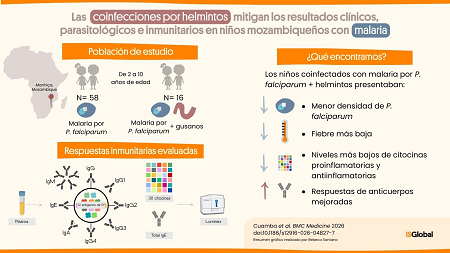
Among the 74 children diagnosed with malaria, 16 were coinfected with helminths, most commonly Strongyloides stercoralis. Coinfected children had significantly lower P. falciparum parasite density and lower body temperature. They also had reduced levels of both pro-inflammatory and anti-inflammatory cytokines, suggesting an overall dampened immune activation. At the same time, antibody responses to several malaria antigens were elevated, including IgG1 and IgG3 responses that have previously been associated with protection. However, the antibody responses most strongly increased during coinfection were not always those linked to lower parasite burden, pointing to a complex immune interplay.
Overall, the results suggest that helminth infections may modulate malaria immunity in ways that reduce disease severity. Coinfection was linked to decreased parasitaemia, downregulation of inflammatory cytokines, and enhanced antibody responses, potentially contributing to milder clinical presentations. “Our findings also indicate a potential role for IgE responses in the protection linked to STH infections, although further research is needed to confirm this,” says Moncunill.
Public health implications
These findings have important implications for disease control strategies in regions where malaria and helminths overlap. “Integrated approaches combining deworming with strengthened malaria surveillance or preventive treatment may be needed to avoid a potential rise in severe malaria cases,” says Dobaño. The authors also stress the need for larger and longitudinal studies to better understand how coinfections shape immunity and to inform future public health interventions.
Reference: Cuamba I, Santano R, Grau-Pujol B et al. Helminth coinfections mitigate clinical, parasitological, and immune outcomes in Mozambican children with malaria. BMC Medicine, 2026. doi: 10.1186/s12916-026-04827-7
Image: Study's Graphical Summary | Author: Rebeca Santano.

La mejor actitud que podemos adoptar es la de trat...

The research team observed changes in head circumf...
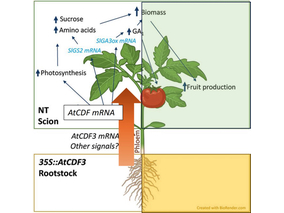
AtCDF3 gene induced greater production of sugars a...
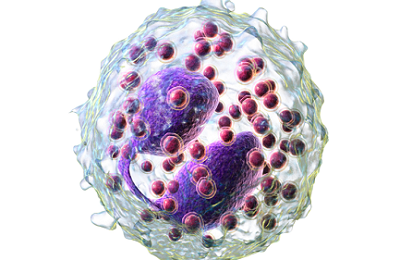
En nuestro post hablamos sobre este interesante tipo de célula del...

Telum Therapeutics, a biotechnology company leveraging proprietary met...