Life begins with a single-cell embryo, which divides to form more cells. At some point during these very early days, each cell’s fate must be decided. Some cells will become the inner cell mass, which forms the future adult body. The rest will form the trophectoderm, an outer layer that will eventually transform into the placenta, a tissue that sustains the embryo as it grows.
Whether a cell ends up becoming the inner cell mass or trophectoderm is the first big decision in embryonic life. It usually happens around the 16-cell stage and represents a point of no return.
Understanding the fundamental principles of this first big decision can help shed light on how embryos form, their placenta develops, how they implant into the womb, and why some embryos fail to progress. A study published today in Science Advances shows how mouse early embryonic cells acquire the ability to make the first cell fate choice in development.
Researchers at the Centre for Genomic Regulation (CRG) in Barcelona and the University of Cambridge in the UK show there is no binary switch where cells suddenly choose their fate. Instead, they prepare for several futures at once before committing to any of them at the sixteen-cell stage.
“We found that cells don’t suddenly decide what fate to acquire but begin to prime themselves much earlier, at the transition to the four-cell stage,” says Dr. Magdalena Zernicka Goetz, senior co-author and researcher at Cambridge University and now at the California Institute of Technology. “This helps explain how early life builds the foundations of the body.”
How embryos get prepared while also keeping options open
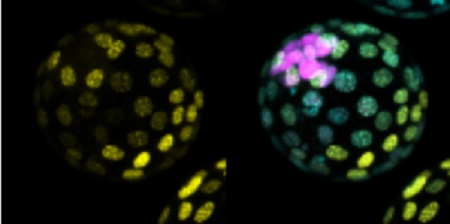
The authors of the study found that CEBPa, a protein that turns genes on or off, also known as a transcription factor, is a key orchestrator. It is expressed transiently before the first bifurcation in the embryo, making a collection of regulatory sequences accessible when active.
When researchers forced embryonic stem cells to make CEBPa, they learned that both the amount of CEBPa and how long it is present matter. If cells only see a little CEBPa, or see it for a short time, they start to look a bit like trophectoderm cells but can still go back to being pluripotent once CEBPa is removed. This appears to be similar to what happens in real embryos, where CEBPa is only switched on at the two-cell to four-cell stage transition before the first major fate decision.
The study also found which regulatory sequences, stretches of DNA that control other genes, are controlled by CEBPa. Many of these regulatory sequences are critical for the expression of trophectoderm fate genes (Tead4, Gata3, Cdx2, Elf5) and are already open in four to eight-cell mouse embryos.
The findings are important because they suggest that early embryos do not wait until fate is decided to remodel their genome, but rather establish a landscape in which trophectoderm genes can be activated rapidly once the right signal arrives.
“CEBPa is working like an architect of future responsiveness in this scenario, helping embryos keep several doors slightly ajar until the moment of choice,” explains Dr. Thomas Graf, senior author of the publication at the Centre for Genomic Regulation.
The study adds weight to the multilineage priming hypothesis, a theory that posits that uncommitted cells express genetic programmes associated with multiple fates before deciding. In other words, stem cells anticipate instructions while keeping their options open before making their first irreversible choice.
Relevance beyond mice
These findings shed light on the rules governing mammalian development, which can also help us understand the earliest chapters of our own biology. However, as they were made in mice, claims about human applications are limited.
The authors of the study found that, as in mice, CEBPa is also specifically expressed in the trophectoderm layer of human blastocysts, although they note that human embryos donated for research are not accessible to examine a potential role of this factor in the earliest stages of life.
Strikingly, human embryos express the transcription factor at later stages than mouse embryos. This may reflect the fact that the genomes of human zygotes aren’t activated until the 8-cell stage, whereas those of mice are activated at the 2-cell stage. This means that human embryos may not be able to express priming factors until later in development.
And while we lack human embryo datasets, studies of human embryonic stem cells have shown that overexpressing CEBPa activates trophectoderm genes. It implies the human genome also responds to CEBPa, though the timing may be shifted in comparison to mice.
Image: Left: a 64-cell mouse embryo showing CEBPa expression in the nuclei of cells (in yellow), coinciding with the trophectoderm, the outer layer that will eventually form the placenta. Right: image merged with the embryo stained for OCT4 expression (in pink) to indicate the future adult body, and for DNA (in blue/green). Credit: Marcos Plana-Carmona, Centre for Genomic Regulation

La mejor actitud que podemos adoptar es la de trat...

The research team observed changes in head circumf...
AtCDF3 gene induced greater production of sugars a...
En nuestro post hablamos sobre este interesante tipo de célula del...

Telum Therapeutics, a biotechnology company leveraging proprietary met...