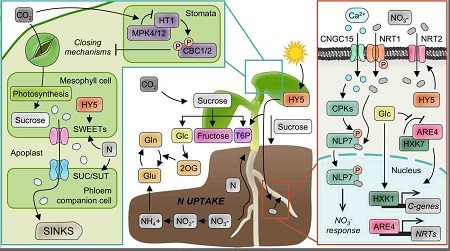
In this work, we explore how plants manage the balance between carbon and nitrogen—two essential elements they need to grow and thrive. We look at the key molecules involved, how plants detect them, and the early signals that help trigger growth and adjust development. By reviewing the latest discoveries, we aim to show just how complex—and fascinating—this internal balancing act really is.
Carbon and nitrogen are the two most important nutrients plants need to grow. For plants to develop properly, these nutrients must be in the right balance. Nitrogen plays a big role in how plants grow, especially in shaping their roots and stems, and it also affects photosynthesis-the process by which they use sunlight to make carbohydrates. On the other side, having enough carbon can help plants absorb and use nitrogen more efficiently.
While we know a lot about how plants sense and use carbon and nitrogen individually, there’s still much to learn about how these two types of nutrients work together. An imbalance between carbon and nitrogen-caused by nutrient limitation in soil and changing weather-can slow down growth and reduce crop yields. In this review, we explore how plants detect and respond to imbalances in carbon and nitrogen. We look at key molecules, how they’re transported in between plant tissues, and how early signals and hormones help plants adjust to changes in their environment.
Original Paper: Fañanás-Pueyo, I., Carrera-Castaño, G., Pernas, M., Oñate-Sánchez, L. 2025. Signalling and regulation of plant development by carbon/nitrogen balance. Physiologia Plantarum 177, e70228. DOI: 10.1111/ppl.70228

La mejor actitud que podemos adoptar es la de trat...

The research team observed changes in head circumf...
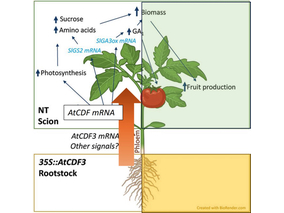
AtCDF3 gene induced greater production of sugars a...
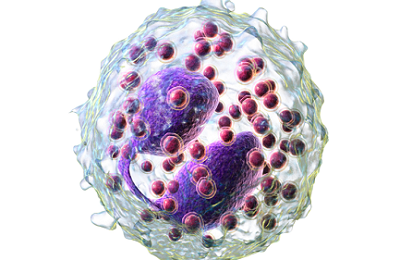
En nuestro post hablamos sobre este interesante tipo de célula del...

Telum Therapeutics, a biotechnology company leveraging proprietary met...