A new study led by a researchers from the Spanish National Research Council (CSIC) at the National Centre for Biotechnology (CNB-CSIC) reveals how alveolar macrophages acquire their identity and specific functions within the lung. Published in the Journal of Experimental Medicine, he study is the result of collaboration with national and international laboratories at the National Centre for Cardiovascular Research (CNIC), the Complutense University of Madrid (UCM) and the Karolinska Institute (Sweden).
The lungs are constantly exposed to particles, microorganisms and potentially harmful agents present in the air we breathe. To protect this vital organ, the immune system relies on specialised cells called alveolar macrophages, which act as sentinels of the lung tissue. In response to signs of damage caused by infections or pathological processes such as inflammation, fibrosis or cancer, these cells trigger immune responses that help to repair the damage and maintain the proper functioning of the tissue.
Mercedes Ricote, leader of the study and researcher at the CNB-CSIC, explains: “The role of macrophages in the lung was already known. This study has uncovered the “learning” mechanism of these cells to specialise and perform their specific functions in the lung “Our work has focused on understanding which cellular processes and elements are necessary to achieve this cellular specialisation.”
The researchers identifiy the RXR protein as an essential element in this process. RXR is a protein found inside cells, where it detects the presence of lipids and vitamin A derivatives. Based on these signals, RXR controls the activation of cellular programmes that allow macrophages to develop correctly and adapt to the lung environment. To carry out these studies, the researchers worked with alveolar macrophages from mice lacking RXR.
“In the absence of RXR, alveolar macrophages neither form nor function correctly; in fact, their numbers decrease due to an increase in cell death,” notes Laura Casablanca, one of the study’s first authors at the CNB-CSIC.
Specialised to improve function
The results obtained have shown that the specialisation of these macrophages does not depend solely on RXR, but also on signals produced by other cells in the lung tissue. These signals work in conjunction with RXR and help the macrophages to adopt their specific identity within the lung. “In the absence of these signals or these receptors, macrophages do not complete their maturation process correctly, which compromises their ability to maintain their proper function in the lung,” concludes Casablanca. Specialisation requires a complex network of regulators and signals that act in a coordinated manner to maintain lung health.
Alveolar macrophages play a crucial role in respiratory conditions that cause chronic inflammation, certain types of lung cancer, or viral infections such as influenza or COVID-19. The knowledge derived from this work could contribute in the future to the development of new therapies to improve the function of the immune system in the lung.
Scientific reference: Jorge Mínguez-Martínez, Jesús Porcuna, Laura Casablanca, Manuel J. Gómez, Hooman Aghelpasand, Pontus Höjer, Belén Garcia-Fojeda, Vanessa Núñez, Carlos Torroja, Severin Mühleder, Charlotte Gustafsson, Thierry Fischer, Rui Benedito, Cristina Casals, Robert Månsson, Fatima Sánchez-Cabo, Mercedes Ricote. A signal-responsive cooperative transcription factor network determines alveolar macrophage identity. Journal of Experimental Medicine 2026, DOI: https://doi.org/10.1084/jem.20242085
CNB-CSIC Communication
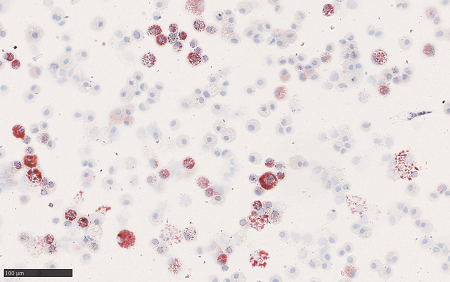
Image: alveolar macrophages obtained from RXR-deficient animals. Laura Casablanca, CNB-CSIC.

La mejor actitud que podemos adoptar es la de trat...

The research team observed changes in head circumf...

AtCDF3 gene induced greater production of sugars a...

En nuestro post hablamos sobre este interesante tipo de célula del...

Telum Therapeutics, a biotechnology company leveraging proprietary met...