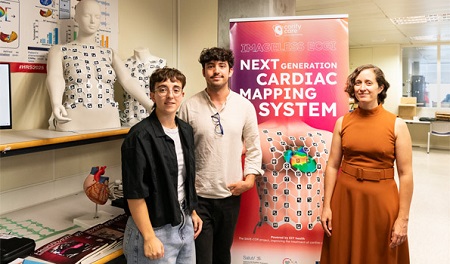
A research team from the Universitat Politècnica de València and the company Corify Care S.L., in collaboration with hospitals in Madrid and Barcelona, has designed an innovative method to study how electricity propagates in the heart. The procedure represents a decisive improvement in non-invasive cardiac mapping technology, known as electrocardiographic imaging (ECGI).
The innovation developed by the COR-ITACA group of the UPV enables much more accurate and consistent maps of cardiac electrical activity without the need for invasive procedures, relying on Bayesian statistical approaches used in fields such as computer vision and pattern recognition.
The work, published in the scientific journal IEEE Transactions on Medical Imaging, represents a decisive step towards safer and more reliable diagnosis of arrhythmias, one of the most common and impactful heart problems in public health.
The challenge of current techniques
To analyse the electrical activity of the heart, electrophysiology typically relies on invasive techniques that require inserting catheters into the organ. Although effective, these procedures are complex, costly and not without risk.
On the other hand, the non-invasive technique of Electrocardiography Imaging (ECGi) uses electrodes placed on the patient's torso to create maps of the heart's electrical activity. It is used to diagnose arrhythmias and guide treatments such as ablation or pacemaker implantation. However, traditional ECGi methods generated maps with errors, making clinical interpretation difficult.
The UPV innovation addresses these shortcomings. ‘This new method overcomes the problems by combining real patient data with mathematical models of electrical propagation, generating more realistic and clinically interpretable maps,’ the research team points out.
Scientific and clinical impact
In simulations, the new Bayesian method achieves much greater accuracy than current techniques, reducing errors by up to 80% and locating the start and end points of electrical activation much more accurately. It has also proven effective in real patients, as it identifies genuine electrical blockages without generating false results.
According to the researchers, this advancement paves the way for faster, safer and more reliable diagnosis of cardiac arrhythmias, with potential applications in planning personalised treatments and improving procedures such as ablation.
‘With this new approach, we are taking another step towards precision medicine in cardiology, using non-invasive methods that can be applied more safely to a greater number of patients,’ conclude the authors of the study.
Reference: Carlos Fambuena-Santos, Clara Herrero, Santiago Ros, Eric Invers-Rubio, Lluis Mont, Ismael Hernández-Romero, Felipe Atienza, Andreu M. Climent and María S. Guillem. Bayesian framework for atrial LAT estimation in ECGI. IEEE Transactions on Medical Imaging.
https://ieeexplore.ieee.org/stamp/stamp.jsp?tp=&arnumber=11143599

La mejor actitud que podemos adoptar es la de trat...

The research team observed changes in head circumf...

AtCDF3 gene induced greater production of sugars a...

En nuestro post hablamos sobre este interesante tipo de célula del...

Telum Therapeutics, a biotechnology company leveraging proprietary met...