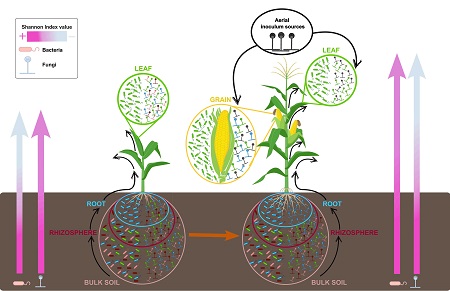
Plants live in constant interaction with an invisible community of microorganisms --known as the plant microbiome --that inhabit the soil, roots, leaves, and even the seeds. These microbial partners can enhance plant growth, improve stress tolerance, and may be key allies in adapting agriculture to climate change.
In this study, we investigated how these bacterial and fungal communities are structured across different parts of maize plants throughout their life cycle, and how they respond to reduced water availability. We tracked the microorganisms in five different plant or soil compartments (or parts): the surrounding soil, the soil directly around the roots (the rhizosphere), the roots themselves, the leaves, and the grains. To understand how water stress affects these microbes, we conducted a field experiment comparing maize grown under optimal irrigation with plants receiving 30% less water, simulating moderate drought stress.
Our findings revealed that maize actively recruits and shapes distinct bacterial and fungal communities in each plant compartment. This selection process is dynamic and compartment-specific: bacterial communities differentiate at early developmental stages, especially in roots and leaves, whereas fungal communities evolve more gradually and take longer to become specialized. Interestingly, fungal communities in the aboveground parts of the plant --leaves and grains --included unique groups that may come from the air, instead from the soil. Our analysis showed that grain-associated bacterial and fungal assemblages grouped differently, with bacterial communities more similar to those in the leaves, while fungal assemblages were equally distinct from both roots and leaves.
Water restriction significantly affected plant growth and yield, as shown by reductions in chlorophyll content, shoot biomass, and grain production. However, the overall structure of the plant-associated microbiome remained relatively stable, suggesting a degree of resilience to this stressor. Notably, fungi were more responsive to water limitation than bacteria, displaying shifts in key fungal groups depending on the plant part and watering regime. These findings suggest that bacteria and fungi fulfill different ecological roles in helping plants cope with environmental stress.
This work underscores the importance of studying microbial communities across the entire plant and across microbial kingdoms. Understanding these interactions could help us find new, sustainable ways to support crops under climate stress --using the natural power of microbes.
Original Paper: Díaz-González, S., González-Bodí, S., González-Sanz, C., Marín, P., Brunner, F., Sacristán, S. 2025. Maize associated bacterial and fungal microbiomes show contrasting conformation patterns dependent on plant compartment and water availability. BMC Plant Biology 25, 448. DOI: 10.1186/s12870-025-

La mejor actitud que podemos adoptar es la de trat...

The research team observed changes in head circumf...
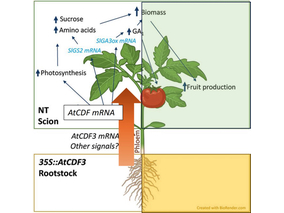
AtCDF3 gene induced greater production of sugars a...

En nuestro post hablamos sobre este interesante tipo de célula del...

Telum Therapeutics, a biotechnology company leveraging proprietary met...