Stroke (cerebrovascular accident, CVA) is one of the leading causes of disability and death, with a significant impact on quality of life and health systems worldwide. In Spain, it affects approximately 120,000 people annually, and in Navarra, it ranks among the leading causes of mortality. Moreover, half of the survivors experience after-effects, and one in four suffers severe disabilities (motor, speech, cognitive, or emotional), which generate high dependency and a significant care burden for families and the healthcare system.
In this context, the development of comprehensive neurorehabilitation strategies (both motor and cognitive) is key, as recovery depends on the brain’s ability to reorganize itself. However, this ability has limits and needs to be supported by personalized, intensive, and sustained therapeutic interventions. The need for more innovative and effective tools for neurological rehabilitation after a stroke is precisely the main motivation behind the launch of the VYSIUM HEALTH project.
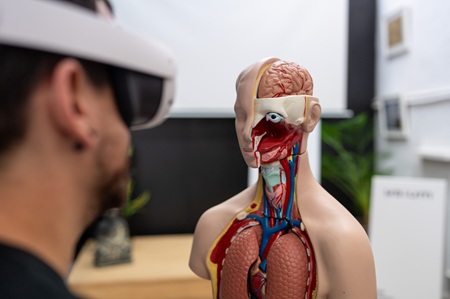
This project is an R&D initiative classified by the Government of Navarra as “strategic,” aiming to develop a multisensory medical device for the detection and personalized treatment of hemineglect and other brain injuries in patients who have suffered a stroke. Hemineglect, one of the most common and disabling cognitive disorders, remains difficult to diagnose and treat due to the lack of truly effective instruments and tools adapted to clinical practice. To address this gap, VYSIUM HEALTH is designing an innovative device that will combine Mixed Reality (MR) and Artificial Intelligence (AI) to create immersive therapeutic environments. In addition, it will allow real-time adjustment of rehabilitation sessions according to each patient’s progress, thereby improving diagnostic accuracy and treatment effectiveness.
For Zuriñe Aguirre, CEO of Ysium Medical, the consortium’s leading company, “VYSIUM HEALTH is a very exciting technological challenge.” “We want to develop a tool capable of seeing better what often goes unnoticed today and, moreover, adapt therapies to each patient and their progress,” she added. In this regard, she highlighted the first goal of their work: “To provide professionals and patients with a solution that marks a before and after in neurological rehabilitation.”
NAVARRESE CONSORTIUM LEADING IN HEALTH, TECHNOLOGY, AND BIOMEDICINE
The VYSIUM HEALTH project, promoted by a consortium of eight leading entities in the fields of health, technology, and biomedicine in the Navarra region, will be carried out over the next two years, until 2027. It will have a total budget of €1,319,898.01 and has received funding from the Government of Navarra, co-financed at 40% by the European Regional Development Fund (ERDF) through the Navarra ERDF Operational Program 2021-2027.
Regarding its members, the project will be led by Ysium Medical, a tech startup specializing in the design and development of innovative medical devices, supported by the artificial intelligence, advanced analytics, and healthcare software company Data Value Management, alongside Zamarripa Ópticos – JUANDAHU, contributing its expertise in advanced optometry and visual therapies. In the field of biomedical research, they will be assisted by the Foundation for Applied Medical Research (FIMA/CIMA), the University of Navarra, and the Public University of Navarra (UPNA). Also involved are the Asociación de Daño Cerebral de Navarra (ADACEN) and Navarra Health Cluster (NHC). The latter will coordinate dissemination, communication, and support in data protection and intellectual property, as well as connection with Navarra’s business and healthcare ecosystem.
The promoters of VYSIUM HEALTH are confident that their R&D+i work will have a direct impact on the regional economy and business landscape, consolidating Navarra as a “hub of innovation in digital health and healthcare technology.” It will also contribute to the creation of qualified employment (in technological, healthcare, and research fields) as well as attracting investments linked to advanced neurorehabilitation solutions. Therefore, the Navarra region “will position itself as a reference in the development of advanced technological solutions for neurological rehabilitation and personalized medicine,” they concluded.

La mejor actitud que podemos adoptar es la de trat...

The research team observed changes in head circumf...
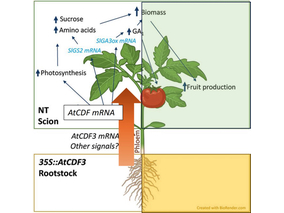
AtCDF3 gene induced greater production of sugars a...
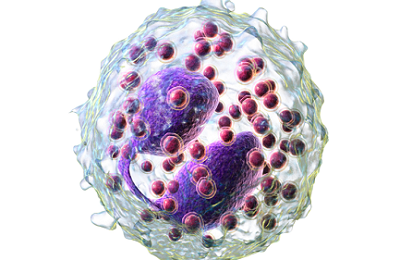
En nuestro post hablamos sobre este interesante tipo de célula del...
GENESIS Biomed ha lanzado el programa GENESIS CEO Academy, una iniciat...