When a plant develops a root, it not only needs to produce new cells but also organize them in the correct locations to form specialized tissues and structures. This process, known as organogenesis, depends on two circuits that must work in unison: on the one hand, the genetic signals that tell each cell what type of cell it should be; on the other, the cell cycle, which controls when and how cells divide.
In both animals and plants, it is known that the moment in the cell cycle at which a cell receives genetic signals can determine its fate. It is also known that there is a close relationship between developmental patterns and cell division.
The cell cycle has several stages. One of them, the G1 phase, is like a strategic period: the cell grows and prepares to duplicate its DNA. However, not all cells go through the G1 phase at the same speed. Differences in the time spent in this stage can influence the speed of plant root growth, as well as the cells' ability to respond to damage to their genetic material.
While the genetic mechanisms that regulate these processes are known in animals, they are still poorly understood in plants. This lack of knowledge is largely due to the difficulties in determining the dynamics of the cell cycle in a growing organ.
A recent study, published in Nature Plants and led by Crisanto Gutiérrez and Bénédicte Desvoyes at the Severo Ochoa Center for Molecular Biology (CBM, CSIC-UAM) in collaboration with Krzysztof Wabnik (Center for Plant Biotechnology and Genomics, CBGP-UPM-INIA/CSIC), sheds light on this enigma. The work, using the model plant Arabidopsis thaliana and a key new tool developed by the CBM group, reveals that a gradient in G1 phase duration acts as an internal clock during root growth.
A highly regulated genetic clock
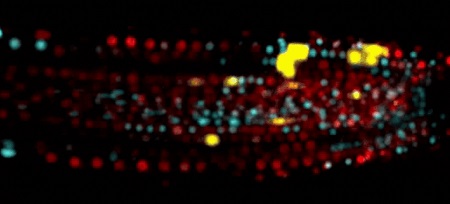
The researchers combined genetics, live-cell microscopy, and spatiotemporal mathematical models to uncover the genetic mechanisms that regulate key developmental transitions in the root. The results showed that cells do not share a common clock: near the meristem boundary (the zone that marks the limit where cells stop dividing and begin to specialize), the G1 phase lasts only 2 hours, while in the immediate descendants of stem cells, it can extend to more than 20 hours.
Crisanto Gutiérrez, a researcher at the CBM, explains that "this clock is controlled by a genetic network that involves developmental genes such as the PLETHORA (PLT) genes, known for maintaining stem cell identity in roots, and cell cycle regulatory genes such as those encoding the RETINOBLASTOMA-RELATED1 (RBR1) and KIP-RELATED PROTEIN 5 (KRP5) proteins."
The G1 phase time gradient does not exist in the early stages of lateral root development, but appears later, suggesting that it is part of a temporally regulated program. Furthermore, in mutant plants in which the gradient had been eliminated, the roots showed greater sensitivity to DNA damage. This suggests that a prolonged G1 phase protects cells closest to the root organizing center, a key area as it regulates stem cells.
The study describes for the first time a G1 phase time gradient in a developing organ. Furthermore, "these findings not only provide an additional level of understanding about how plants coordinate growth and differentiation, but also open the door to practical applications: fine-tuning this clock could help design crops with more resilient roots that are more efficient at absorbing resources," explains Bénédicte Desvoyes, a researcher at the CBM.
Ultimately, roots not only grow according to a genetic plan, but also measure time with an internal clock. A clock that, thanks to the action of key genes, ensures that each cell divides at the right time and that the plant grows in an orderly and resilient manner.
Image: Animated gif of the meristem ‘clock’ of an Arabidopsis thaliana / CBGP
Original Paper: Echevarría, C., Desvoyes, B., Marconi, M., Franco-Zorrilla, J.M., Lee, L., Umeda, M., Sablowski, R., Birnbaum, K.D., Wabnik, K., Gutierrez, C. 2025. Stem cell regulators drive a G1 duration gradient during plant root development. Nature Plants 1–11. DOI: 10.1038/s41477-025-02109-3

La mejor actitud que podemos adoptar es la de trat...

The research team observed changes in head circumf...
AtCDF3 gene induced greater production of sugars a...
En nuestro post hablamos sobre este interesante tipo de célula del...

Telum Therapeutics, a biotechnology company leveraging proprietary met...