The alliance between Rhizobium bacteria and legumes provides agricultural systems with a sustainable source of nitrogen, in contrast to the use of fertilizers. However, for this interaction to occur, a molecular dialogue between the plant and the bacteria must be established. Once achieved, nodules form on the roots, where the bacteria fix atmospheric nitrogen and subsequently transfer it to the plant. At the same time, the bacteria are completely dependent on the nutrients provided by the legume, which activates zinc uptake mechanisms that appear to be essential both for adapting to the conditions imposed by the plant and for the bacteria’s own functioning.
Previous studies have shown that a series of bacterial proteins are differentially expressed in the symbiosis of Rhizobium leguminosarum with pea and lentil plants. It is now suspected that these unusual molecules may be involved in the adaptation of the bacteria to their legume host. Among them, a metal-binding protein, part of a transporter system, was identified, showing higher expression levels in symbiosis with pea plants, suggesting that the availability of this nutrient is more limited in this legume. Genome analysis of this Rhizobium species also revealed the presence of a high-affinity zinc transporter system, whose function has also proven to be key for symbiosis.Essential in pea and lentil
In the study published in the journal Frontiers in Plant Science by researchers from the CBGP, it is demonstrated that at least one of the two transporter systems must be present to allow bacterial growth under zinc-limiting conditions. The authors have found that the expression of both systems in the symbiosis of Rhizobium leguminosarum is induced in response to low concentrations of this metal.
Furthermore, the results show that both systems are essential for achieving optimal symbiotic performance in the two host plants: pea and lentil. The researchers identified three histidine residues, conserved in other zinc-binding proteins, that are crucial for the function of the metal-binding protein overexpressed in pea, possibly by participating in zinc coordination.
These findings, along with the fact that the expression of the legume-dependent transporter system increases in pea compared to the levels observed in lentil, suggest that this system may play an auxiliary role in zinc uptake under deficiency conditions and be important in the adaptation of the bacteria to its legume host.
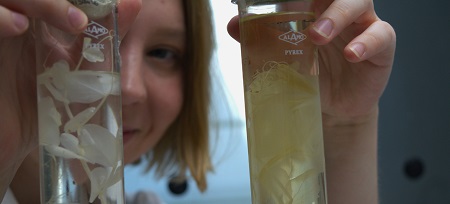
Image: Joanna N. Soldek, first author of the article, looking at legumes with and without symbiotic nodules / CBGP
Original Paper: Soldek, J.N., Ballesteros-Gutiérrez, M., Díaz-Sáez, L., Delgado-Santamaría, I., Palacios, J.M., Albareda, M. 2025. Two zinc ABC transporters contribute to Rhizobium leguminosarum symbiosis with Pisum sativum and Lens culinaris. Frontiers in Plant Science 16. DOI: 10.3389/fpls.2025.1598744

La mejor actitud que podemos adoptar es la de trat...

The research team observed changes in head circumf...

AtCDF3 gene induced greater production of sugars a...

En nuestro post hablamos sobre este interesante tipo de célula del...

Telum Therapeutics, a biotechnology company leveraging proprietary met...