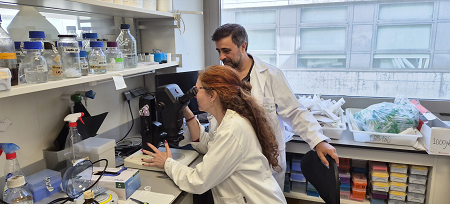
Roots are the organs that enable plants to detect and respond to nutrient deficiencies in the soil. However, not all root cells behave in the same way. For years, this response has been studied as a global process, but in reality, each cell type plays a distinct role. Understanding these differences provides deeper insight into how plants adapt and opens the door to designing crops that make better use of available nutrients.
The CBGP researchers analyzed what happens inside different types of root cells when phosphorus becomes scarce. They examined the activity of thousands of genes under conditions close to natural environments, and the results show that each cell type responds in a specific way: different genes are activated, and distinct regulatory mechanisms are triggered in each case. One of the most relevant findings is that, in addition to “switching” genes on or off, cells also modify how genes are expressed through a process known as “alternative splicing,” which allows a single gene to generate different versions of the same genetic information. This mechanism acts as an additional layer of control and plays a key role in the plant’s adaptation to phosphorus deficiency.
The study also identifies several important regulators that coordinate these responses. Among them is a protein called SR45, which helps distribute phosphorus within the plant. When this protein does not function properly, phosphorus accumulates more in the roots than in the aerial parts, and plant growth is reduced, highlighting its fundamental role in maintaining internal nutrient balance.
Researchers provide a detailed view of how roots manage phosphorus scarcity at the level of individual cells. This knowledge represents an important step toward the development of more efficient and sustainable crops, capable of growing better in nutrient-poor soils and reducing the need for fertilizers.
Original Paper: González-García, M.-P., Lanza, M., Baca-González, V., Bustillo-Avendaño, E., Serrano-Ron, L., González-Bodi, S., García-Mina, J.M., Zamarreño, Á.M., Garnica, M., Moreno-Risueno, M.A., Caro, E., del Pozo, J.C.✉ 2026. Phosphate starvation induces root cell-type-specific transcriptional responses and alternative splicing. New Phytologist. DOI: 10.1111/nph.71144

La mejor actitud que podemos adoptar es la de trat...

The research team observed changes in head circumf...
AtCDF3 gene induced greater production of sugars a...
En nuestro post hablamos sobre este interesante tipo de célula del...

Telum Therapeutics, a biotechnology company leveraging proprietary met...