Researchers from the University of Zaragoza at the Institute of Nanoscience and Materials of Aragon ( INMA ), a joint center of the Spanish National Research Council (CSIC) and the University of Zaragoza, have developed platinum nanoparticles capable of significantly increasing the effectiveness of radiotherapy in cancer , in collaboration with the Carlos III Health Institute, the Spanish National Cancer Research Centre (CNIO) and the University of Elche.
The study demonstrates that these particles act through an innovative dual physical and chemical mechanism , successfully halting tumor growth and increasing survival in animal models . This breakthrough was led at INMA by Miguel Encinas, José Ignacio García-Peiró, José Luis Hueso, and Jesús Santamaría. INMA is the only Severo Ochoa Center of Excellence in Aragon, and the research is part of one of the Institute's strategic lines, focused on the development of advanced cancer therapies.
A major advance for radiotherapy.
The work addresses one of the main obstacles in radiotherapy: tumor hypoxia, or oxygen deficiency within solid tumors . Tumors grow so rapidly that their blood vessels are defective, creating an oxygen-deprived environment (hypoxia). Radiotherapy damages the DNA of cancer cells, but in a hypoxic environment, that damage is not irreversible, and the tumor can repair itself and become resistant to treatment.
Researchers have designed platinum nanoparticles less than 3 nanometers in size (Pt nanoparticles), thousands of times smaller than the thickness of a human hair . These particles can be administered intravenously or directly into the tumor and possess a key property: they act simultaneously through two complementary pathways and cooperate in the death of cancer cells.
On the one hand, platinum (Pt) significantly increases the effectiveness of radiation due to its high absorption coefficient (resulting from its high atomic number), amplifying the Compton effect and the production of secondary electrons, which multiply the direct damage to the DNA of tumor cells. On the other hand , the catalytic action of Pt generates oxygen locally , which reverses hypoxia and hinders cellular repair, prolonging the damage caused by radiation to tumor cells. In other words, it prevents the tumor from repairing the damage caused by radiation , thus increasing the effectiveness of the treatment.
Furthermore, studies have not detected systemic toxicity , and the ultra-small size of the nanoparticles used facilitates their gradual elimination from the body via urine.
So far, the experiments have been conducted using cell and animal models , and the effectiveness of Pt nanoparticles in enhancing the effects of radiotherapy has been demonstrated. However, the researchers emphasize that the study is in the proof-of-concept phase, still far from potential clinical application.
In a little more detail: the "double effect" to attack cancer
The potential of this study lies in the fact that these tiny platinum particles exert a dual effect , increasing the damage to tumor cells through two different pathways at the same time, with a physical and a chemical effect.
-Physical effect (radiation amplifier): Platinum (Pt) is a heavy chemical element with a high atomic number. This means it acts like a "sponge," increasing the effective radiation received by the patient. Upon absorption, a physical reaction occurs (Compton amplification) causing the platinum to release "secondary electrons" around it . It's as if the radiation impacts the platinum, generating microscopic shrapnel that multiplies the direct damage to the tumor's DNA.
-Chemical effect (the oxygen factory): This is where chemistry comes into play. Platinum has a catalytic effect , meaning it can accelerate chemical reactions, in this case by mimicking the behavior of a natural enzyme in our body called catalase. What exactly does it do? It breaks down the hydrogen peroxide (oxygenated water) present in the tumor at higher concentrations than in healthy cells, and transforms it into oxygen locally . By increasing the oxygen concentration in the tumor microenvironment, hypoxia decreases , making it more difficult for the tumor cell to repair the damage caused by radiation.
By combining these two effects, a significant reduction in tumor growth has been achieved using low doses of radiation . Furthermore, the characteristics of these particles are key to minimizing side effects: These nanoparticles inherently exhibit good biocompatibility, meaning they generate minimal toxicity in healthy cells. Moreover, their small size allows them to pass through the kidneys, facilitating their gradual elimination by the body through urine.
The authors
Miguel Encinas, José Ignacio García-Peiró, José Luis Hueso, and Jesús Santamaría are researchers at INMA (CSIC-Unizar) and members of the Department of Chemical Engineering and Environmental Technologies at the University of Zaragoza, the Aragon Health Research Institute (IIS Aragón), the Biomedical Research Networking Center for Bioengineering, Biomaterials and Nanomedicine (CIBER-BBN), and Unit 9 of the NANBIOSIS Singular Scientific and Technical Infrastructure. Researchers Antonio De la Vieja, Maria Pilar Martín-Duque, and Laura Notario , from the Carlos III Health Institute, also participated. Other contributors included Eduardo Caleiras, from the CNIO, and Felipe Hornos, from the Institute for Research, Development and Innovation in Health Biotechnology of Elche.
The article can be found here:
Ultrasmall Platinum Nanoparticles for Radiation-Enhanced Cancer Therapy
Advanced Functional Materials (2026) https://doi.org/10.1002/adfm.202600051
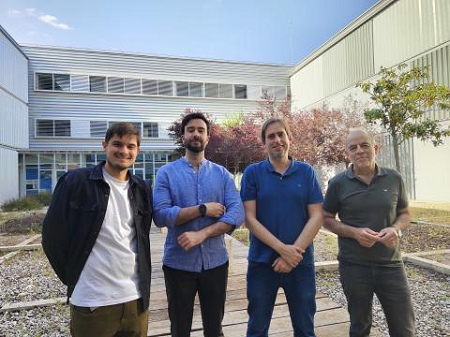
Image: part of the research team that developed the work, from left to right: Ignacio García-Peiró, Miguel Encinas, José Luis Hueso and Jesús Santamaría.

La mejor actitud que podemos adoptar es la de trat...

The research team observed changes in head circumf...

AtCDF3 gene induced greater production of sugars a...

En nuestro post hablamos sobre este interesante tipo de célula del...

Telum Therapeutics, a biotechnology company leveraging proprietary met...