In the framework of the international CBGP-CEPLAS project, the research group of Dr. Wabnik in collaboration with Dr. Jiménez Gómez has proposed a general model for the photoperiod-dependent regulation of circadian clocks across plant species. This study shows common regulatory principles and key differences in transcriptomes of core clock genes, controlling florigens.
The timing of key developmental transitions-flowering, growth cessation, and tuberization-directly shapes crop yield, making it a crucial focus in agriculture. Plants finely tune these transitions in response to seasonal changes in daylight (photoperiod) throughout the year. Based on their sensitivity to photoperiod, they are classified into two major groups: Long-Day Plants (LDPs) and Short-Day Plants (SDPs).
At the heart of this timing mechanism is the CETS gene family (CENTRORADIALIS/TERMINAL FLOWER 1/SELF-PRUNING), which includes flowering signals (florigens) and their inhibitors (anti-florigens). Their expression is controlled by both environmental cues and the circadian clock, an internal 24-hour rhythm pace-maker. While the core players are conserved in LDPs and SDPs, their interactions and regulatory strategies differ.
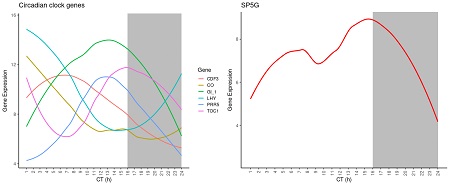
We developed a predictive model to uncover the similarities and differences in photoperiodic responses between LDPs and SDPs. Using time-course transcriptomic data, we built a system of Ordinary Differential Equations (ODEs) that captures the dynamic relationship between circadian clock genes and CETS regulation. The model successfully predicts seasonal expression patterns of CETS, revealing distinct activation and repression dynamics in LDPs versus SDPs.
Beyond predictions, our findings highlight the intricate crosstalk between internal biological clocks and external environmental cues, showing how plants fine-tune their photoperiod sensing to optimize growth and reproduction. This model offers new insights into plant adaptation and has the potential to inform agricultural strategies for improving crop performance under changing climate conditions.
Original Paper: González-Delgado, A., Jiménez-Gómez, J.M., Wabnik, K. 2025. Regulatory principles of photoperiod-driven clock function in plants. . DOI: 10.1016/j.tplants.2025.01.008

La mejor actitud que podemos adoptar es la de trat...

The research team observed changes in head circumf...

AtCDF3 gene induced greater production of sugars a...

En nuestro post hablamos sobre este interesante tipo de célula del...

Telum Therapeutics, a biotechnology company leveraging proprietary met...