The Institute for Advanced Chemistry of Catalonia (IQAC-CSIC) organized a series of talks and a roundtable titled “Noves tecnologies i coneixement científic per a millorar l’Agricultura” (New technologies and scientific knowledge to improve agriculture) as part of the European Researchers’ Night. The event, which took place at Ateneu Santfeliuenc (Sant Feliu de Llobregat, Barcelona), featured researchers Ricardo Molina, Carme Quero, Ramon Crehuet, and Evgeny Bulatov (from the Institute of Environmental Assessment and Water Research, IDAEA-CSIC). The session was moderated by researcher Daniel Carbajo from IQAC-CSIC.
European Researchers’ Night takes place every year on the last Friday of September in over 300 cities across 30 countries in Europe. Its goal is to bring research, innovation, and the people behind it — scientists — closer to the public in an engaging and accessible way. This allows audiences of all ages — from schools, families, and children to young people and adults — to discover and engage with the science happening in their region. In Catalonia, this major event has been held for over five years, offering more than 200 outreach activities in venues such as universities, museums, and civic centers.
Dr. Evgeny Bulatov, a researcher at IDAEA-CSIC, presented research focused on monitoring water quality. Current legislation on reclaimed water, such as Royal Decree 1085/2024 (which regulates its reuse for various purposes including irrigation), controls parameters like turbidity and bacteria (e.g., E. coli), but does not include organic contaminants.
A key concern is organic microcontaminants, including pesticides, pharmaceuticals, and other substances, which pose a significant risk given the increasing need to use reclaimed water for irrigation.
To tackle this issue, researchers are using ceramic passive samplers (CPS). This new technology enables more precise and cost-effective detection of pesticides and microcontaminants in water. Recent sampling of wastewater effluents and reclaimed water has revealed the presence of pharmaceutical contaminants. Using CPS allows for efficient and low-cost management of these pollutants.
Dr. Carme Quero’s team at IQAC-CSIC focuses on Integrated Pest Management (IPM), a set of complementary strategies for sustainable control that minimize insecticide use. To ensure agricultural sustainability, the European Union, through its Farm to Fork strategy (2020), has set a target to reduce chemical insecticide use by 50% by 2030.
A key component is semiochemicals, chemical compounds emitted by living organisms that trigger specific responses in others. These include pheromones (intraspecific signals, such as sexual or aggregation signals) and allelochemicals (interspecific signals).
These natural signals can be used in various strategies: monitoring population density; mass trapping to reduce populations; sexual confusion; and attract-and-kill or repulsion-attraction approaches.
Research at IQAC-CSIC includes identifying new semiochemicals, such as testing the efficacy of γ-hexalactone combined with ammonium bicarbonate to control the olive fruit fly (Bactrocera oleae). This combination increased captures of both sexes compared to ammonium bicarbonate alone.
Designing a chemical compound selective for a specific insect species is very challenging. This challenge is also the basis for using animal models in drug discovery, as both rely on specific molecular differences. One way to overcome this difficulty is to identify mechanisms unique to pest insects.
In this context, pheromones are highly species-specific molecules. Computational technology plays a key role in reducing costs and speeding up the design of compounds targeting pheromone receptors by generating structural models of the receptors and calculating the affinity of potential compounds — an approach similar to pharmaceutical development.
Dr. Ricardo Molina leads research on applying Non-Thermal Plasma (NTP) technology. Plasma is the most common state of matter in the universe, a fully or partially ionized gas.
NTP technology can generate active nitrogen and oxygen species from ambient air, which dissolve in water to create Plasma Activated Water (PAW). PAW is being studied for its potential to increase crop yields and help fight diseases.
Plasma applications include:
This innovative work is carried out through international collaborations with researchers from research centers and universities in Argentina, Bolivia, Tunisia, and Mauritania.
The project is co-funded by the European Union’s Horizon Europe research and innovation program.
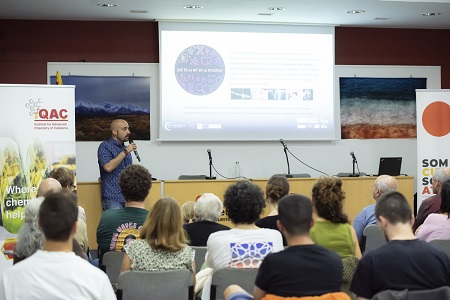
Image: Researcher Daniel Carbajo moderating the activity. Source: Margarita Bulatova

La mejor actitud que podemos adoptar es la de trat...

The research team observed changes in head circumf...
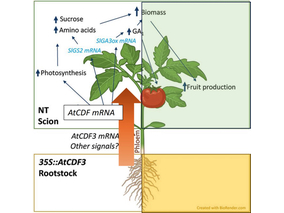
AtCDF3 gene induced greater production of sugars a...
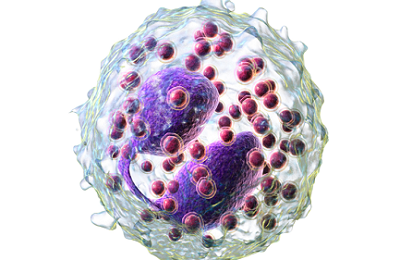
En nuestro post hablamos sobre este interesante tipo de célula del...

Telum Therapeutics, a biotechnology company leveraging proprietary met...