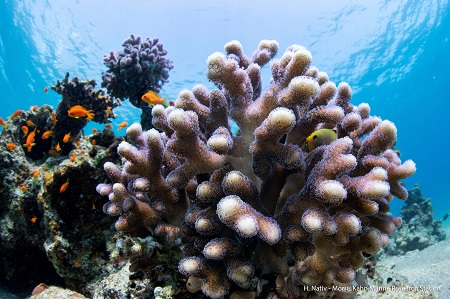
Earth’s oceans harbour many creatures big and small, including ancient animal lineages which hold vital clues to one of biology's most profound mysteries: how did the many different types of cells which compose complex organisms – like neurons, skin cells and muscle cells – evolve over time?
A team of scientists at the Centre for Genomic Regulation (CRG) is embarking on an ambitious project to map the evolutionary relationships between different animal cell types by studying the primordial dwellers of the seas. Using advanced genetic tools, they aim to map out a family tree of cell types, providing new insights into the building blocks of life.
The project is backed by a 2-million-euro Consolidator Grant from the European Research Council, announced today (3 December).
The project will focus on Cnidaria, a group of animals which includes jellyfish, corals, and sea anemones. These creatures are ideal for studying because they have a wide variety of cell types with both conserved and unique features. They are also an ancient animal lineage, having existed for over 550 million years during life’s long history on Earth.
"Cnidarians are one of our most distant animal relatives" says ICREA Research Professor Arnau Sebé-Pedrós, coordinator of the grant and researcher at the Centre for Genomic Regulation (CRG) and the Wellcome Sanger Institute in the UK. " They provide a unique window to reconstruct the ancient origins of some types of cells, as well as to help us understand how new cell types continuously emerge in evolution,” he adds.
To achieve their objectives, the group will use advanced techniques in single-cell genomics and computational biology. They will delve into the molecular programs which define a cell’s identity, such as the specific genes that are active in each cell and how they are regulated.
The researchers are particularly interested in DNA sequences known as regulatory elements, which act like switches, turning genes on or off. By analysing how these regulatory sequences have changed over time, the group hopes to understand how new cell types came to be.
Dr. Sebé-Pedrós has previously shown that placozoans, pancake-shaped animals which graze in shallow seas and are closely related to cnidaria, have neuron-like cells. Given they first appeared on Earth hundreds of millions of years ago, his work provides a plausible theory that the cells served as a blueprint for the nervous systems which later arose in more complex animals, including humans.
The funding from the European Research Council will help the group create new, more accurate evolutionary trees of cell types and test longstanding hypotheses, including the question of whether certain cell types like neurons evolved once or multiple times independently in different lineages.
The work also lays the foundation for "cell systematics," a new framework for classifying cell types based on their evolutionary relationships, much like how species are classified in taxonomy.
A family tree of cell types could revolutionise biology and medicine. Cell types are the building blocks of life and knowing how they change over time helps us understand the evolution of complex life forms at cellular level resolution. They can also reveal how changes to DNA at the molecular level led to new cell functions and structures, contributing to the diversity of life.
The grant will also ultimately contribute to the Biodiversity Cell Atlas project, an incipient global effort to create detailed maps of all the different types of cells in many different organisms similar to those created as part of the Human Cell Atlas initiative. Dr. Sebé-Pedrós is coordinator of the Biodiversity Cell Atlas project.

La mejor actitud que podemos adoptar es la de trat...

The research team observed changes in head circumf...
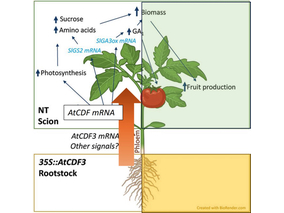
AtCDF3 gene induced greater production of sugars a...
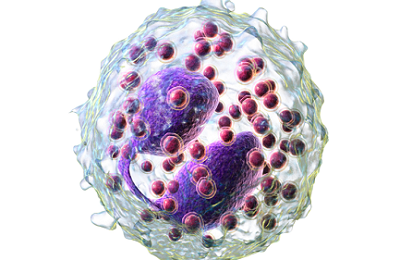
En nuestro post hablamos sobre este interesante tipo de célula del...

Telum Therapeutics, a biotechnology company leveraging proprietary met...