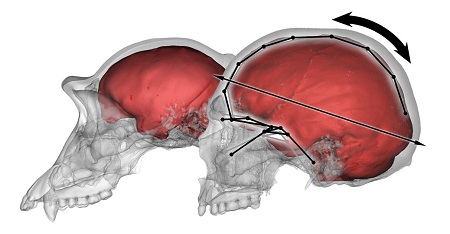
Sofia Pereira Pedro and Emiliano Bruner, from the Paleoneurology Group at the Centro Nacional de Investigación sobre la Evolución Humana (CENIEH), have just published a study in the Journal of Anatomy on the relationship between the parietal bone in the skull and the orientation of the head in modern humans, whose results suggest that the size of these bones does not influence the shape of the face, but does affect its orientation.
The study uses techniques from geometric morphometry, based on spatial models and multivariate statistics, to establish the shape of the different anatomical zones of the skull and their relative position.
The parietal regions of the skull are particularly large and rounded in Homo sapiens in comparison with other hominins and the great apes. Another difference is seen in the position of our orbits, which are positioned entirely below the brain only in our species. Expansion of the parietal regions tilts the axis of the brain, and therefore the functional axis of the head.
“The larger the parietal region is, the more marked is the rotation of the orbits and the cranial base. Considering this spatial influence, the expansion of these regions in Homo sapiens must have been accompanied by secondary adjustments relating to the orientation of the head, the distribution of the weights in gravitational equilibrium and patterns of locomotion”, explains Bruner.

La mejor actitud que podemos adoptar es la de trat...

The research team observed changes in head circumf...

AtCDF3 gene induced greater production of sugars a...
En nuestro post hablamos sobre este interesante tipo de célula del...

Telum Therapeutics, a biotechnology company leveraging proprietary met...