Cotyledons are the first embryonic leaves to emerge during plant germination and play a key role in the early stages of development. Upon first exposure to light, cotyledons expand and become the seedling’s first photosynthetic tissue. Despite their importance, the expansion process of cotyledons has been little studied, and the exact regulatory mechanism was unknown until now.
In a study recently published in The Plant Journal, the research group led by Elena Monte, a CSIC scientist at the Centre for Research in Agricultural Genomics (CRAG), has described for the first time the molecular mechanism that regulates cotyledon expansion during seedling development.
The key role of cotyledons
Cotyledons are crucial structures for the establishment of the future plant. Once the seedling germinates from the seed, the cotyledons, often rich in lipids, serve as a source of nutrients to promote its development. While the seedling remains in darkness, typically buried underground, the cotyledons (two in the case of dicotyledonous plants such as Arabidopsis) are small and held together. Exposure to light triggers a series of mechanisms that completely transform the seedling in a process known as de-etiolation. This process involves total reprogramming, including changes such as the inhibition of hypocotyl elongation, the development of chloroplasts, and the unfolding and expansion of the cotyledons. These then become the seedling's first photosynthetic tissue, allowing it to become autotrophic, capable of producing its own nutrients through photosynthesis.
In this study, conducted by postdoctoral researcher Nil Veciana in collaboration with researcher Guiomar Martín, the CRAG research team observed that during cotyledon expansion, the different cellular layers follow distinct growth patterns. In the epidermis, the outermost layer, cells expand by adopting a characteristic “puzzle piece” shape that reduces mechanical stress on the cell wall and prevents distortions caused by increased pressure. In contrast, in the palisade mesophyll, the cell layer beneath the epidermis, cells not only expand but also divide. This is the first time this phenomenon has been described, as it was previously thought that cell expansion was the only mechanism involved in cotyledon growth. Cell division during cotyledon expansion could be a strategy to minimize and manage the mechanical stress experienced by this tissue, which lacks the puzzle shape. An increase in cell division also raises the number of chloroplasts and thus enhances the cotyledons’ photosynthetic capacity during de-etiolation.
Finally, the research team concludes that although these two mechanisms are coordinated, the regulation of expansion and cell division are decoupled processes governed independently. Expansion appears to depend on mechanical forces between the two layers, whereas cell division is regulated by light and the specific cell type.
Molecular regulation
During the process of de-etiolation, the transition from darkness to light, photoreceptors play a key role, particularly phytochromes, proteins that detect red light and initiate a signaling cascade that ultimately leads to changes in the expression of specific genes. This cascade involves PIFs (short for Phytochrome Interacting Factors), which are transcription factors that regulate gene expression in response to light.
Using mutants of the model plant Arabidopsis thaliana, the research team has determined that PIFs are responsible for inhibiting both cell expansion in the epidermis and expansion and division in the palisade mesophyll. In the absence of PIFs, the cotyledons expand even in darkness, although they do not turn green due to the lack of light.
The researchers also observed that for this expansion process to take place, intact chloroplasts are essential. In fact, Arabidopsis seedlings with damaged chloroplasts, either due to excessively intense light or the presence of a chemical compound that harms chloroplasts, are unable to expand their cotyledons. The protein GUN1 is involved in this process; it is essential for chloroplasts to act as environmental sensors and inhibit cotyledon expansion under conditions of excessive light, thereby reducing exposure and protecting the seedling.
Cotyledons as a model for studying layerered growth
Studying how the area of photosynthetic tissue is regulated is of great importance, as it is a key process for the plant and will determine its photosynthetic capacity. This study establishes for the first time that cotyledons and their expansion process during de-etiolation are an excellent model to investigate how growth and shape control are regulated. Adult leaves are structures where many processes occur simultaneously, making it difficult to isolate this specific mechanism.
This work provides new insight into how plants regulate their initial growth in response to light, highlighting the complexity and precision of the molecular mechanisms involved in seedling development.
Moreover, this model can be applied to other tissues and even beyond plants, as these results could have implications for other multilayer processes such as organ development in animals, where coordination between cell layers is essential.
Reference article: Nil Veciana, Guiomar Martín, and Elena Monte. A PIF-regulated switch in cell axis growth drives cotyledon expansion through tissue-specific cell expansion and division. The Plant Journal, https://doi.org/10.1111/tpj.70196
About the authors and funding of the study
This work was supported by grants from FEDER/Ministerio de Ciencia, Innovaci!on y Universidades – Agencia Estatal de Investigaci!on (Project References BIO2015-68460-P, PGC2018-099987-B-I00, and PID2021-122288NB-I00 to E.M.; and RYC2020-030160-I to G.M.), and from the CERCA Programme/Generalitat de Catalunya (Project References 2017SGR-718 and 2021SGR-792 to E.M.). We acknowledge financial support from the Spanish Ministry of Economy and Competitiveness, through the ‘Severo Ochoa Programme for Centres of Excellence in R&D’ 2016–2019 (SEV-2015-0533) and CEX2019-000902-S funded by MCIN/AEI/10.13039/501100011033.
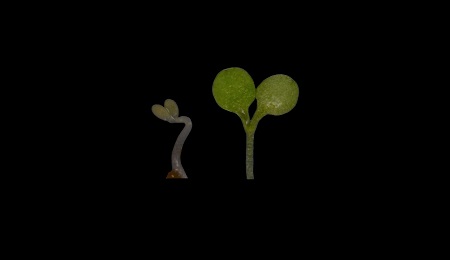
Image: (Left) Cotyledons of 2-day-old seedlings grown in darkness; (right) Seedlings exposed to red light for 48 hours.

La mejor actitud que podemos adoptar es la de trat...

The research team observed changes in head circumf...
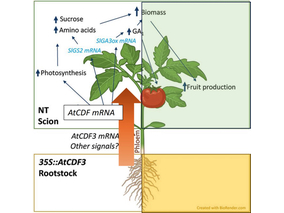
AtCDF3 gene induced greater production of sugars a...
En nuestro post hablamos sobre este interesante tipo de célula del...

Telum Therapeutics, a biotechnology company leveraging proprietary met...