Researchers at CRAG have taken a crucial step toward improving tomato production in cold climates. They have identified and enhanced the levels of key molecules in cell membranes, known as glycosylated sterols (GS), which not only provide the plant with tolerance to low temperatures but do so without hindering its development or growth.
The study, led by CRAG scientists Albert Ferrer and Teresa Altabella, and published in the journal Plant Physiology, opens the door to developing more robust tomato (Solanum lycopersicum) varieties.
The tomato’s Achilles heel
Due to its tropical origin, tomatoes are notoriously sensitive to cold temperatures, especially those ranging from 0 to 12 °C. The optimal growing temperature for tomato is between 20 and 28 °C, and dropping below 10–12 °C negatively affects its development.
Until now, most studies on cold resistance had focused on plants where glycosylated sterols were minor components. But in tomato, and generally in the Solanaceae family, GS are the predominant sterol form in their membranes. CRAG researchers have shown that these GS act as key sensors that detect cold stress and activate protective molecular mechanisms.
The secret of “pre-conditioning”
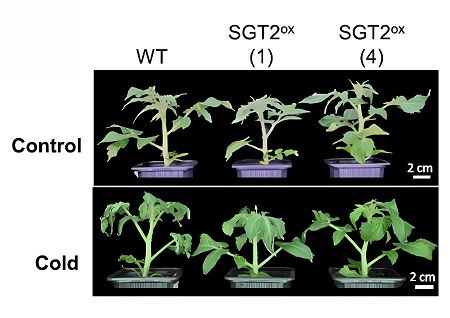
To test this function, the team worked with transgenic lines of the MicroTom® variety. They increased GS production by overexpressing the SlSGT2 enzyme (SGT2ox plants) and decreased GS by silencing the SlSGT1 enzyme (SGT1ami plants). These two enzymes are responsible for synthesising GS. The result was clear and, according to Albert Ferrer, CRAG researcher and co-author of the study, “it’s not common to observe such clearly antagonistic phenotypes”:
The key to resistance lies in the fact that high GS levels stabilize the plasma membrane. Moreover, these glycosylated sterols give the plant a “pre-conditioned” stress response state, meaning an early response even before they are exposed to the cold.
This protective state involves early molecular activation of defences:
Agronomic implications
The great biotechnological potential of this research lies in the fact that, unlike other genetic modifications, increasing GS had no negative effect on plant growth or development under normal cultivation conditions.
“We’ve shown that glycosylated sterols not only protect the membrane but activate a complete molecular response that prepares the plant to withstand cold”, explains Teresa Altabella, CRAG researcher and co-author of the study.
Modifying these metabolic pathways could be a viable strategy for agriculture, enabling the development of tomato varieties more resistant to cultivation in fields exposed to low temperatures or in greenhouses that do not require heating, which would translate into significant benefits in terms of yield and productivity.
Reference Article
Cuiyun Deng, Antoni Garcia-Molina, Aurelio Gómez-Cadenas, Vicente Vives-Peris, Rubén Alcázar, Albert Ferrer, Teresa Altabella. Glycosylated sterols enhance cold tolerance in tomato via membrane stabilization and jasmonate signaling. Plant Physiology (2025), https://doi.org/10.1093/plphys/kiaf420
About the authors and funding of the study
This work was funded by grants PID2021-126591OB-I00 from the FEDER/Ministerio de Ciencia, Innovación y Universidades–Agencia Estatal de Investigación (MCIN/AEISpain), 2021-SGR-00875 from the CERCA Programme of the Generalitat de Catalunya; CEX2019-000902-S from the MCIN/AEI/10.13039/501100011033 (Spain); . Research in the laboratories of Dr. A. Gómez-Cadenas and Dr. Rubén Alcázar has been supported by grants UJI-B2022-18 (Universitat Jaume I, Castellón, Spain) and PID2021-126896OB-I00 (FEDER/Ministerio de Ciencia, Innovación y Universidades, Spain), respectively. Cuiyun Deng received a Ph.D. fellowship (CSC202109110067) from the China Scholarship Council (China).

La mejor actitud que podemos adoptar es la de trat...

The research team observed changes in head circumf...
AtCDF3 gene induced greater production of sugars a...

En nuestro post hablamos sobre este interesante tipo de célula del...

Telum Therapeutics, a biotechnology company leveraging proprietary met...