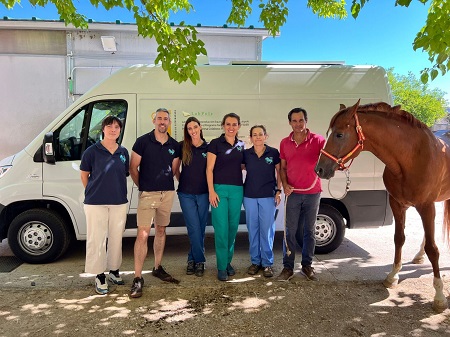
The Equine Reproduction and Spermatology research group at the University of Extremadura is working to identify which bacteria naturally inhabit the uterus of healthy mares, to understand how this microbiota interacts with the immune system and helps protect against infections.
Infectious endometritis, or uterine infection, is one of the main causes of infertility in mares. In addition to hindering pregnancy, it can cause embryonic loss and abortions, with economic consequences for the equine sector. Until recently, it was believed that the mare's uterus was a sterile environment, devoid of bacteria. However, this team of researchers from the Faculty of Veterinary Medicine at the UEx has demonstrated that the uterus of mares and donkeys has a unique uterine microbiota, as has been observed in women and other species, and that one of its functions is to protect it from invasion by pathogenic bacteria.
In this regard, UEx researchers have found that the uterine microbiomes of healthy mares and those with endometritis exhibit significant differences in composition and diversity. Furthermore, they have observed that some bacterial species traditionally considered pathogenic may be present. These bacteria are found in very low proportions in a uterus with a balanced microbiome, which challenges the traditional idea that the uterus must be a sterile environment.
Now, the research team is analyzing the relationship between the microbiota and the mare's uterine immune system, a topic of great interest also in human reproduction, with the aim of improving the diagnosis and treatment of endometritis. Thus, the research team, led by Cristina Ortega Ferrusola , has recently been awarded a second project in this line of work: the MIUMEEE project, funded by the Ministry of Science, Innovation and Universities, which strengthens and consolidates the group's track record in this field.
New therapeutic approach
This new research project seeks to understand how the uterine microbiota influences local immune mechanisms and how its alteration can trigger infertility. Within the framework of this project, researchers hope to improve the diagnosis of mares with this condition and develop new alternative treatments to antibiotics that restore and maintain microbial balance. A new therapeutic approach is being developed through the development of probiotics (beneficial live bacteria) and postbiotics (bacterial-derived products that slow the growth of pathogens and modulate the immune system). “Our goal is not only to better understand endometritis, but also to lay the foundation for new, antibiotic-free therapies that respect the natural balance of the uterus. We must consider the uterine microbiota as an ally,” says Cristina Ortega Ferrusola.
This research is aligned with the global fight against antibiotic resistance established in the National Plan against Antibiotic Resistance (PRAN), which has been added to the restrictions on the use of antibiotics in veterinary medicine imposed by Royal Decree 666/2023, which regulates the distribution, prescription, dispensing, and use of veterinary medicines in Spain. "More than 60% of mares with fertility problems who attend the Equine Reproduction Center-UEx have infectious endometritis," says Ortega Ferrusola. "Currently, the treatment of uterine infections in this species involves the administration of antibiotics. However, the emergence of resistant strains and restrictions on the use of these drugs in veterinary medicine are making their management and resolution difficult," the researcher points out.
Biomarkers to improve diagnosis
Diagnosing endometritis is not easy, and in subclinical cases, the disease can go undetected in many mares. Considering that results from traditional diagnostic methods are not always conclusive, the team is investigating new biomarkers (immunological, protein, and bacterial) in uterine lavage and biopsies to improve diagnosis. Thus, the project combines various molecular techniques known as "omics," which allow the identification of bacteria through sequencing, as well as their proteins and metabolites. These innovative techniques will help us understand the bacteria present in the uterus and how they influence their environment. "The goal is also to better understand the biological processes that affect fertility. Furthermore, this project aims to identify bacteria with postbiotic potential capable of improving the immune response and promoting microbial balance in the uterus of mares," Ortega emphasizes.
Growth of equine farming
This is a key issue for a booming livestock industry, especially in Extremadura. The equine sector has experienced 39% growth in the last decade, according to the 2022 Second Study on the Impact of the Equestrian Sector in Spain published by the Ministry of Agriculture, Fisheries, and Food. Horse breeding has doubled, "and equine farming covers many fields of activity: leisure, culture, sports, equestrian therapy, among others," explains the UEx researcher.
The study involves mares with reproductive problems who attend the UEx Equine Reproduction Center-Veterinary Clinical Hospital for diagnosis and treatment. The study also includes collaboration with CENSYRA (Animal Selection and Reproduction Center) of the Regional Government of Extremadura. Recently, the Equine Reproduction and Spermatology research group signed a collaboration agreement with Yeguada Cartuja (EXPASA SME) , the National Equine Reference Center . This will increase the number of tested mares, both healthy and with fertility problems, thus boosting research in the equine sector.
In 2026, the University of Extremadura's Equine Reproduction Center , located in the Faculty of Veterinary Medicine, will celebrate 20 years of operation. Over these two decades, the center has established itself as an international benchmark thanks to its research, with more than 120 scientific publications, several patents, and doctoral theses, the result of public funding for competitive projects. This work has fostered the transfer of knowledge to the livestock sector, improving fertility diagnostics and assisted reproduction techniques, which has boosted equine breeding and strengthened the sector in Extremadura.
Reference:
Da Silva Álvarez, E., Martín Cano, FE, Gómez-Arrones, V., Gaitskell-Phillips, G., Alonso, JM, Rey, J., Becerro, L., Gil, MC, Peña, FJ, & Ortega Ferrusola, C. (2024). Bacterial endometritis-induced changes in the endometrial proteome in mares: Potential uterine biomarker for bacterial endometritis. Theriogenology, 226 , 202–212. https://doi.org/10.1016/j.theriogenology.2024.06.009
Da Silva-Álvarez, E., Gómez-Arrones, V., Correa-Fiz, F., Martín-Cano, FE, Gaitskell-Phillips, G., et al. (2025). Metagenomic and proteomic analyzes reveal similar reproductive microbial profiles and shared functional pathways in uterine immune regulation in mares and jennies. PLOS ONE, 20 (4), e0321389. https://doi.org/10.1371/journal.pone.0321389
Microbiome and Uterine Immunity Project : Endometrial Multiomics (Proteomics/Metabolomics/Cytomics/Metagenomics) in the Study of Equine Endometritis
Reference: PID2023-149815OB-I00 Funding Entity: State Research Agency (Ministry of Science, Innovation and Universities)
Duration: 01/09/2024 – 31/12/2028
Budget: €267,500
Principal Investigator: Cristina Ortega Ferrusola
Institution: University of Extremadura
Image: Research Group: Clara Zabalo Palomo, Francisco E. Martin Cano, Eva Da Silva Alvarez, Cristina Ortega Ferrusola, Laura Becerro Rey and Manuel Cabello Romero

La mejor actitud que podemos adoptar es la de trat...
The research team observed changes in head circumf...
AtCDF3 gene induced greater production of sugars a...
En nuestro post hablamos sobre este interesante tipo de célula del...

Telum Therapeutics, a biotechnology company leveraging proprietary met...