NutriSenior 2030 is a social innovation project that aims to improve nutrition and promote healthy aging among people over 65 by drawing on their own experiences, habits, and everyday challenges related to food. The project is funded by the Ministry of Social Rights, Consumer Affairs, and Agenda 2030, has a duration of one year, and concludes at the end of 2026.
“It is necessary to understand how older people actually eat and what difficulties they encounter in their daily lives . The project seeks to learn about their eating habits, taking into account possible socioeconomic barriers, problems when shopping, reading labels, cooking or preserving food, as well as changes in diet associated with retirement, loneliness or living with family,” explains María Luisa Timón .
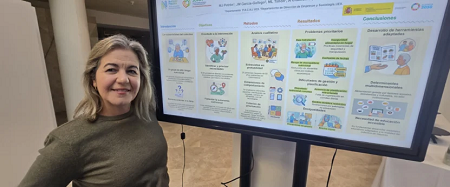
To this end, the research team conducted 30 in-depth interviews with people over 65 years of age from diverse socioeconomic backgrounds and from both urban and rural areas of Extremadura. The in-depth interviews were conducted individually, either in the participants' homes or in agreed-upon public spaces. Subsequently, the work carried out at the Senior Citizens' Fair and at the University for Seniors of the University of Extremadura (UEx) allowed for the verification and confirmation of the main results obtained in the interviews, while also incorporating new contributions and experiences from older adults.
Preliminary results show that eating habits vary significantly depending on age, whether one lives alone or with a partner, and the presence of family members, such as children or grandchildren . The study reveals that eating patterns change markedly when a person lives alone, especially after retirement, and that in many cases, mealtimes and schedules become more irregular.
Qualitative analysis has also identified different profiles, such as women who traditionally handle shopping and cooking, men who delegate these tasks, and older people, especially those between 65 and 70, who are digitally active. This diversity is key to adapting the project's solutions to different social and technological realities.
Based on these results, NutriSenior 2030 will develop a practical nutrition guide and a very simple mobile application , designed for easy access, primarily via WhatsApp . The tool will offer clear, concise recommendations tailored to the actual habits of older adults, aiming to make technology a help, not a barrier. More information on participating in this project and the app can be found on the NutriSenior 2030 profiles on Facebook and Instagram , and on the website: https://www.nutrisenior2030.es/
Interview with María Luisa Timón on the podcast Brotes de Ciencia : Brotes de Ciencia (05/05/2026) | EXPlay Canal Extremadura
Source: Scientific Culture Dissemination Service of the UEx
The project is coordinated by María Luisa Timón Andrada , professor at the University of Extremadura (UEx), and has an interdisciplinary team made up of researchers from the Food Technology area of the School of Agricultural Engineering and professors from the areas of Business Management and Sociology of the Faculty of Economics and Business and the School of Industrial Engineering , responsible for the qualitative analysis of the data obtained.

La mejor actitud que podemos adoptar es la de trat...

The research team observed changes in head circumf...
AtCDF3 gene induced greater production of sugars a...

En nuestro post hablamos sobre este interesante tipo de célula del...

Telum Therapeutics, a biotechnology company leveraging proprietary met...