An international team led by the MRC Laboratory of Molecular Biology (LMB) in Cambridge, UK, and including researchers from the University Institute for Research in Biocomputation and Physics of Complex Systems (BIFI) at the University of Zaragoza, has deciphered the structure and function of the GluA3 brain receptor, which is key to neurological diseases such as epilepsy and schizophrenia. Published in Nature , the study uses cryo-electron microscopy and computational simulations to show how this receptor adopts a unique architecture among AMPA receptors, with its extracellular domains coupled together like a "molecular switch" that enables rapid brain signaling.
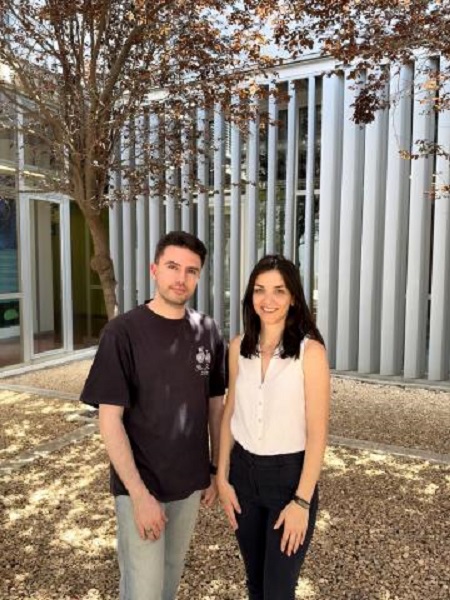
Researcher Carlos Vega Gutiérrez (University of Zaragoza) spent time with Ingo Greger's group at the MRC Laboratory of Molecular Biology, where he applied a protein production method developed by Beatriz Herguedas , a researcher at the BIFI institute. This technique allowed for the generation of large quantities of GluA3 in its natural (unmutated) state and the resolution of its atomic structure using cryo-electron microscopy.
The structure reveals that the new interfaces harbor mutations linked to epilepsy and schizophrenia, and identifies a unique region in the receptor that could be modulated with drugs. According to Herguedas: "Understanding the unique structure of GluA3 allows us to explain how certain mutations cause disease. Furthermore, we are beginning to complete the structural puzzle of AMPA receptors, which will allow us to identify new, more specific modulation pathways for these receptors that are essential for neuronal communication."
PUBLICATION DATA:
Image: Beatriz Herguedas and Carlos Vega Gutiérrez, researchers at the BIFI Institute-University of Zaragoza

La mejor actitud que podemos adoptar es la de trat...

The research team observed changes in head circumf...
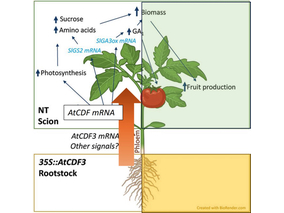
AtCDF3 gene induced greater production of sugars a...
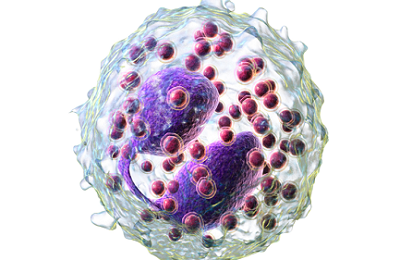
En nuestro post hablamos sobre este interesante tipo de célula del...

Telum Therapeutics, a biotechnology company leveraging proprietary met...