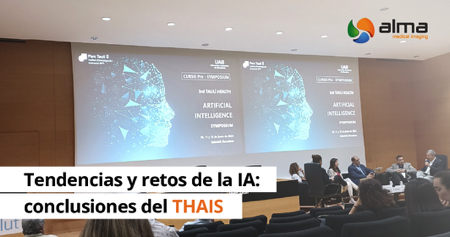
On June 11 and 12, the Alma Medical Imaging team attended the third Tauli Health Artificial Intelligence Symposium (THAIS), organized by Unidad Mixta del grupo de Nefrología Clínica, Intervencionista y Computacional (CICN), from Instituto de Investigación e Innovación del Parc Taulí (I3PT), and School of Engineering of the Universidad Autónoma de Barcelona.
Led by Dr. José Ibeas, THAIS took place at the Parc Taulí Hospital in Sabadell, providing insights into the challenges and trends of AI in clinical practice. Undoubtedly, it was an enriching experience from which we have drawn valuable conclusions for Alma’s activities, summarized below.
Access to Data, Key for AI Adoption in Medicine
Access to data was one of the fundamental points reviewed during the symposium, as it is essential for adopting artificial intelligence in clinical practice.
Specifically, we discussed two types of data usage:
Various models were discussed during the sessions to ensure the secondary use of information: debates included opt-in and opt-out approaches, the possibility of giving credit in scientific works to physicians who provide data to enhance motivation, and the European Health Data Space initiative, which aims to promote the sharing of medical data within the EU through the following lines of work:
Interpretability of Models, a Challenge to Overcome
The interpretability of models is another critical issue that needs special attention to promote AI adoption in clinical practice.
In some models, the output is derived from nonlinear combinations of inputs, sometimes with multiple hidden layers, making interpretability challenging and consequently reducing the trust that physicians place in this technology. To overcome this barrier, several methods were discussed at THAIS:
Heat Map
AI-based automatic medical image analysis uses complex convolutional networks that are not easily interpretable at first glance. One proposed option to improve interpretability is to show a heat map on the original image that identifies the areas given the most weight.
SHAP Method (SHapley Additive exPlanations)
The SHAP method calculates the impact of different input variables on the model output, distinguishing which types of values lead to a particular output. This method can be combined with the XGBoost algorithm, a type of random forest where the decision trees are sequentially linked to improve the parts that fail in the previous tree.
NEAR Method
The NEAR method uses the SHAP method to find the variables with the most weight in the output and then constructs a model using only these variables, which has been shown to be significantly more explainable than the original.
Artificial Intelligence in Spain
After reviewing these topics, it is worth asking where Spain stands in this sector. Here are some AI research lines revealed at the symposium:
Thus, research is on the right track to incorporate artificial intelligence into medicine. The challenge? Creating business models that allow for gradual and evaluable integration of these new technologies.
Alma Medical Imaging and the Central Role of AI
At Alma, we pride ourselves on the fact that artificial intelligence has become a central and strategic part of our solution, which is why training like THAIS enriches us as a team.
Here are some of our lines of work to improve AI implementation in the radiological workflow:

La mejor actitud que podemos adoptar es la de trat...
The research team observed changes in head circumf...
AtCDF3 gene induced greater production of sugars a...
En nuestro post hablamos sobre este interesante tipo de célula del...

Telum Therapeutics, a biotechnology company leveraging proprietary met...