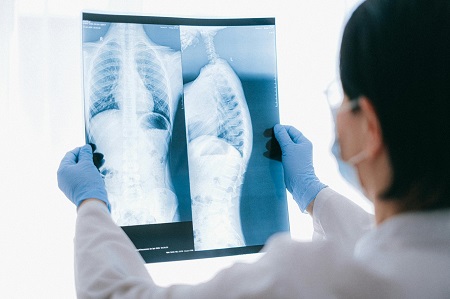
Researchers at Pompeu Fabra University (UPF) in collaboration with Hospital del Mar have developed computational models that simulate spinal surgeries customized for each patient. This technology aids in detecting and preventing risks prior to the operation so that the surgical intervention can be carried out more safely.
Specifically, they have developed virtual models to simulate corrective surgeries for adult spine deformity (ASD), a pathology that alters the vertebral alignment and postural balance of the patient and causes pain and functional limitation. To correct this deformity, complex assemblies called instrumentations must be made, which consist of placing screws inside the vertebrae connected by rods. The vertebrae that bear screws and are part of the instrumentation are called instrumented vertebrae. Despite advances in medicine, these interventions involve significant risks of mechanical complications, such as proximal junctional failure (PJF), which affects the union between the last upper instrumented vertebra and the first adjacent mobile vertebra located just above. This problem can cause different injuries, ranging from fractures in the vertebrae to compression of the spinal cord, with serious consequences such as disabling pain, inability to stand upright or mobility problems in the legs. This can affect some 30% of patients, and resolving it requires a further surgical procedure.
To meet this challenge and find a compromise between the degree of spinal correction and the risk of PJF and lower the need for a second surgery, a team of researchers from the BCN MedTech Research Unit of the UPF Department of Engineering in collaboration with Hospital del Mar has developed sophisticated, patient-specific computational models of the thoracolumbar spine, the transitional zone between the thoracic cage and the lumbar spine. These in silico models allow virtually recreating different surgical scenarios and biomechanical forces, and provide quantitative data that complement existing clinical evaluations.
Thanks to the collaboration with Hospital del Mar, which has provided the clinical hypothesis and real clinical cases to validate the simulations, the researchers have been able to focus on the most complex, highest risk patients, who present a special challenge for the surgical procedure. This approach allows adjusting the surgical strategy to the characteristics of each patient before entering the operating room.
The results of this research were recently published in an article in The Spine Journal, the world’s leading scientific journal on spine surgery. The study was led by Jérôme Noailly, head of the Biomechanics and Mechanobiology (BMMB) research area of the BCN MedTech Unit of the UPF Department of Engineering, with Morteza Rasouligandomani, a researcher from the same group, as first author.
Safer spine surgery with fewer implants
The study shows that a specific surgical strategy, called implant density reduction (IDR), can significantly reduce postoperative complications. IDR consists of using fewer screws strategically to fix the spine, thus reducing the stress on the discs and improving the stability of the implants. In patients with healthy bones and titanium implants, the study indicates that this technique can reduce the stress on the discs by up to 70% and improve the stability of the remaining screws by more than 140%.
The planned, strategic distribution of the screws per vertebra throughout the operated region allows the spine to better withstand natural stresses after surgery and reduce the risk of complications, as Rasouligandomani explains: “Strategically reducing the number of implants allows a more progressive transition of stiffness between the fused and unfused parts of the spine, which helps mitigate the stress that leads to failure of the proximal junction”.
Planificación quirúrgica personalizada
This study also represents a major step towards personalized surgical planning for patients with adult spinal deformity. As Noailly states: “Using computer simulations, we can test different surgical strategies on a specific patient before entering the operating room. This allows us to identify the optimal approach to minimize the risk of complications and improve clinical outcomes”.
Dr. del Arco: “Collaboration between engineers and surgeons is key to advancing patient care. Computer simulations provide a powerful tool to anticipate and prevent complications, especially in the complex, high-risk cases that we usually see in clinical practice”.
Along the same lines, Dr. Alex del Arco, assistant physician of the Spine Functional Unit of the Neurosurgery Service of Hospital del Mar who collaborated in the study -which provided the clinical hypothesis-, highlights the importance of this joint work: “Collaboration between engineers and surgeons is key to advancing patient care. Computer simulations provide a powerful tool to anticipate and prevent complications, especially in the complex, high-risk cases that we usually see in clinical practice”.
Despite their promising results, the researchers stress that IDR is not a universal solution. Its effectiveness depends on factors such as the patient’s bone quality, the material of the implants (titanium or cobalt-chromium) and the severity of the deformity. In patients with osteoporosis or very severe deformities, IDR may not be sufficient to prevent PJF.
This breakthrough opens the door to safer and more personalized spine surgery, with the potential to reduce repeat operations, improve patient quality of life, and optimize health system resources. This study was made possible thanks to the support of the European Research Council, through the O-Health project (ERC-CoG-2021-101044828). The team is already working to turn this technology into a health product in the near future, so that society can benefit from it.
Reference article: Rasouligandomani M.; Arco A.d.; Villa T.; La Barbera L.; Gonzalez Ballester M.A.; Galbusera F.; Noailly J. Implant density reduction to avoid proximal junctional failure in adult spine surgery: Computer models and simulations. North American Spine Society Journal 2025; 24
https://www.nassopenaccess.org/article/S2666-5484(25)00190-8/fulltext

La mejor actitud que podemos adoptar es la de trat...

The research team observed changes in head circumf...
AtCDF3 gene induced greater production of sugars a...
En nuestro post hablamos sobre este interesante tipo de célula del...

Telum Therapeutics, a biotechnology company leveraging proprietary met...