Allergy is a worldwide disease characterized by an exacerbated immune response to a normally tolerated molecule. Novel approaches as VLPs have been proposed to enhance the effectiveness, safety, and convenience of allergy therapy. The review presents an overview of VLPs and the current state of the art in allergy research.
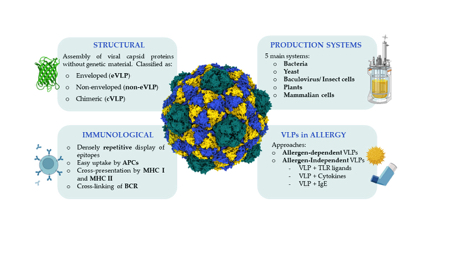
Immune engineering and modulation are the basis of a novel but powerful tool to treat immune diseases using virus-like particles (VLPs). VLPs are formed by the viral capsid without genetic material, making them non-infective. However, they offer a wide variety of possibilities as antigen-presenting platforms, resulting in high immunogenicity and high efficacy in immune modulation, with low allergenicity.
Both animal and plant viruses are being studied for their use in the treatment of food allergies. These formulations are combined with adjuvants, TCR epitopes, TLR ligands, and other immune mediators to modulate or enhance the immune response toward the presented allergen.
In the manuscript Berreiros-Hortala and Vilchez-Pinto present the actual state of the use of VLPs in allergy. First, the authors introduce what VLPs are, looking at their structural features, their production using different systems, and the immunological mechanisms behind their formulation to be promising vaccine candidate. Within this context, the authors delve into the applicaction of VLPs in allegy treatment, focusing in the different formulations that are nowadays in the clinical reasearch.
Therefore, the review aims to show an update on the powerfull tools that VLPs are not only for the treatment or prevention of infectious diseases but also for the tretment of allergies, as model of other autoimmune diseases.
Original Paper: Berreiros-Hortala, H., Vilchez-Pinto, G., Diaz-Perales, A., Garrido-Arandia, M., Tome-Amat, J. 2024. Virus-like Particles as Vaccines for Allergen-Specific Therapy: An Overview of Current Developments. 25, 7429. DOI: 10.3390/ijms25137429

La mejor actitud que podemos adoptar es la de trat...

The research team observed changes in head circumf...
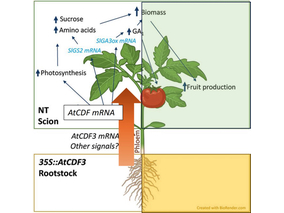
AtCDF3 gene induced greater production of sugars a...
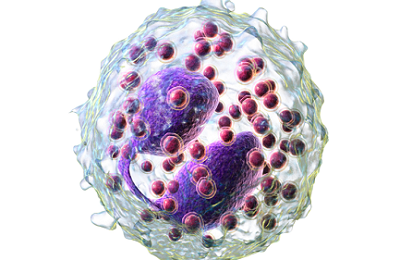
En nuestro post hablamos sobre este interesante tipo de célula del...

Telum Therapeutics, a biotechnology company leveraging proprietary met...