Researchers from Dr. Couce’s lab at CBGP (UPM-INIA/CSIC) have shown that mutualistic bacterial communities can revert to autonomy to escape environmental stress, through metabolic rewiring that depends on both the bacterial strain and the type of stress. The study, led by Dr. Melero-Jiménez—Margarita Salas Fellow at CBGP—was conducted.
CBGP-authored work just published in Nature Communications reveals that, in the face of life-threatening stress, breaking mutualistic ties can be a successful strategy for bacterial communities to ensure survival. The study was spearheaded by Dr. Melero-Jiménez, Margarita Salas Fellow in Dr. Couce’s lab at CBGP.
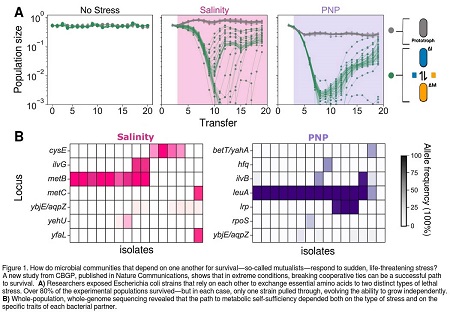
The researchers investigated how microbial communities that rely on each other for survival-specifically, bacterial strains that cross-feed essential amino acids-cope with sudden and lethal environmental stress. While evolutionary rescue, the process by which organisms rapidly adapt to avoid extinction, has been studied in isolated species, little was known about how it unfolds in tightly linked mutualistic systems.
Their findings were striking: more than 80% of experimental populations survived two very different types of lethal stress. But in every case, only one of the bacterial partners made it through-by evolving a way to live independently, no longer needing its partner's help to obtain amino acids. In fact, mutualistic pairs were more vulnerable to stress than bacteria capable of fending for themselves from the start. This suggests that mutualisms, despite their benefits, can also carry hidden fragilities when the environment turns hostile.
Moreover, the study shows that the routes to metabolic self-sufficiency can be shaped by both the nature of the stress and the specific physiology of each bacterial strain. These insights deepen our understanding of how cooperative relationships evolve and break down in nature, and have practical implications for biotechnology, where engineered microbial partnerships are increasingly used in industry and environmental applications.
Original Paper: Melero-Jiménez, I.J., Sorokin, Y., Merlin, A., Li, J., Couce, A., Friedman, J. 2025. Mutualism breakdown underpins evolutionary rescue in an obligate cross-feeding bacterial consortium. Nature Communications 16, 3482. DOI: 10.1038/s41467-025-58742-1

La mejor actitud que podemos adoptar es la de trat...

The research team observed changes in head circumf...
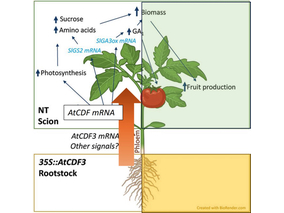
AtCDF3 gene induced greater production of sugars a...
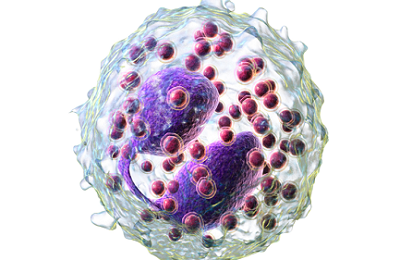
En nuestro post hablamos sobre este interesante tipo de célula del...

Telum Therapeutics, a biotechnology company leveraging proprietary met...