During embryonic development, the intestine of the Drosophila fly divides into distinct chambers thanks to the formation of constrictions at specific points of the tissue. The Wingless (Wg) signalling pathway is known to be responsible for one of these constrictions but until now the underlying mechanism regulating this was not known.
A study led by Dr. Delia Ricolo and Dr. Jordi Casanova at IRB Barcelona, published in the journal EMBO reports, has unveiled that Wingless triggers calcium entry, which leads to a change in cell polarity, reorganizing the cytoskeleton and allowing contraction of the tissue. As a result, the intestine becomes divided into distinct specialized regions.
"We knew that Wingless participates in the development of the intestine, but the underlying mechanism remained unclear. We now know that calcium plays a key role in this process," explains Dr. Ricolo, first author of the work.
The research demonstrates that the activation of Wingless triggers cellular reorganization that allows contraction of the tissue and the formation of the constrictions that lead to the final shape of the fly intestine.
This finding not only contributes to our understanding of embryonic development in insects but also expands the effects of the Wingless signalling pathway, which has been highly conserved throughout evolution. This study sheds light on how biochemical signals can transform cellular architecture during embryonic development. A greater understanding of these mechanisms could give insights into diseases related to morphogenesis and organ development in distinct organisms.
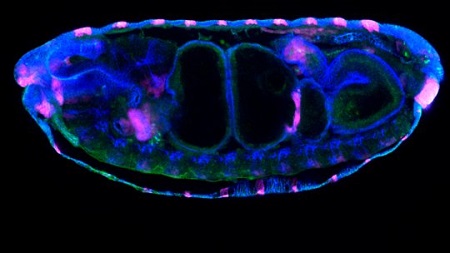
Image: The Drosophila ebryo's midgut forms wih an endodermal layer (green) encased by visceral mesoderm (blue). Three constrictions divide the gut, with Wingless (magenta) shaping the middle one.
Related article: Autocrine Wingless constricts the Drosophila embryonic gut by Ca+2-mediated repolarisation of mesoderm cells
Delia Ricolo, Francesca Tamba & Jordi Casanova
EMBO reports (2024) DOI: 10.1038/s44319-025-00411-x
About IRB Barcelona
The Institute for Research in Biomedicine (IRB Barcelona) pursues a society free of disease. To this end, it conducts multidisciplinary research of excellence to cure cancer and other diseases linked to ageing. It establishes technology transfer agreements with the pharmaceutical industry and major hospitals to bring research results closer to society, and organises a range of science outreach activities to engage the public in an open dialogue. IRB Barcelona is an international centre that hosts 400 researchers and more than 30 nationalities. Recognised as a Severo Ochoa Centre of Excellence since 2011, IRB Barcelona is a CERCA centre and member of the Barcelona Institute of Science and Technology (BIST).

La mejor actitud que podemos adoptar es la de trat...

The research team observed changes in head circumf...
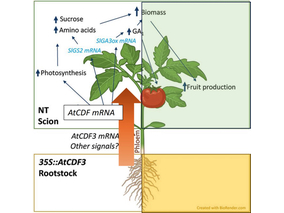
AtCDF3 gene induced greater production of sugars a...
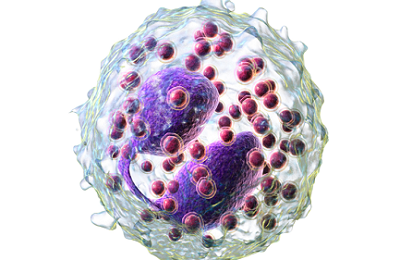
En nuestro post hablamos sobre este interesante tipo de célula del...

Telum Therapeutics, a biotechnology company leveraging proprietary met...