Researchers have shown that a type of fat molecule, long associated with signalling at the cell's outer membrane, also operates inside the nucleus on a schedule that matches the rhythm of cell division.
The discovery, published today in Advanced Science, suggests a previously unrecognised layer of control over how cells divide, with potential relevance for understanding cancer.
The study, led by scientists at the Centre for Genomic Regulation (CRG) in Barcelona in collaboration with groups in Vienna and Florence, focuses on a lipid called PIP2 and an enzyme called PIP5K1A that produces it.
The idea that metabolic enzymes and lipids can be found inside the nucleus is only now starting to gain traction in biology. This study adds a significant new dimension by showing that nuclear lipid metabolism follows a precise timing linked to cell division, with PIP5K1A and its product PIP2 both rising and falling in abundance at specific stages of the cycle.
"What we show for the first time is that metabolic components inside the nucleus are dynamically regulated across the cell cycle, rather than sitting there as a static feature of the cell," said Toni Gañez, first author of the study.
During cell division, DNA must be tightly condensed into compact chromosomes so that the genome can be properly split between two daughter cells. This process of chromatin condensation is essential. Errors can lead to cells with too many or too few chromosomes, a hallmark of cancer.
When the researchers disrupted the nuclear lipid pathway, chromatin condensation during division was altered. The effect was reversed when they restored the enzyme, but only when it was directed specifically to the nucleus. A version kept outside the nucleus did not fully do the job.
The finding suggests that fats, which can be structural or signalling molecules, also actively participate in genome regulation, following a precise nuclear rhythm tied to cell division.
"Disturbing this pathway changes how chromatin is regulated, which suggests a real connection between nuclear lipid metabolism and the control of cell division," Gañez said.
To check that the findings reflected normal biology, the team also looked at samples of healthy human tissue, including the liver and pancreas. They found the same lipid and enzyme present inside the nuclei of cells across multiple organs, with patterns mirroring those seen in the laboratory.
The findings have implications for understanding human health and disease because cancer cells are known to rely on altered metabolism and uncontrolled division. Because the enzymes and chromatin processes examined in this study are already known to play roles in cell proliferation, the authors suggest that nuclear lipid metabolism could turn out to be relevant in disease settings, though further work will be needed to establish that directly.
The study also adds to a growing body of work from Sara Sdelci's lab at the CRG that is steadily redrawing the map of what happens inside the nucleus. Earlier studies from the same group have shown that more than two hundred metabolic enzymes, many normally associated with energy production in the mitochondria, sit directly on top of human DNA, and that different cancer types carry distinct "nuclear metabolic fingerprints."
Other work has revealed that mitochondria physically rush to the nucleus when cells are squeezed, delivering an emergency burst of energy to repair damaged DNA, and that "moonlighting" metabolic enzymes play unexpected second roles in cell division and DNA repair.
The new study extends this picture into the world of lipids, reinforcing the view of the nucleus as a dynamic metabolic hub rather than simply a storage place for DNA, and suggesting that this hidden metabolic life runs on a clock set by cell division itself.
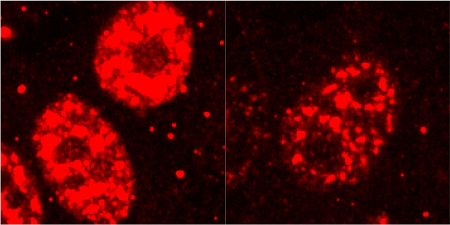
Imagen: Cells showing changes in nuclear lipid levels, shown in red. Credit: Toni Gañez/Centro de Regulación Genómica

La mejor actitud que podemos adoptar es la de trat...

The research team observed changes in head circumf...
AtCDF3 gene induced greater production of sugars a...
En nuestro post hablamos sobre este interesante tipo de célula del...

Telum Therapeutics, a biotechnology company leveraging proprietary met...