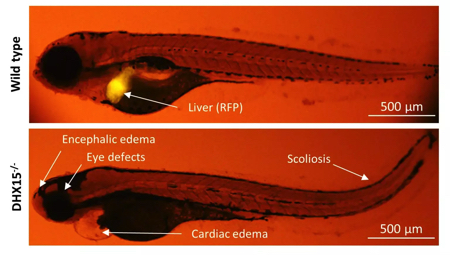
A recent study, published in the International Journal of Molecular Sciences, suggests that the Dhx15 gene could be a target for diagnosing and treating liver diseases such as cancer.
The research, carried out entirely at the Clínic-IDIBAPS, was led by Dr. Manuel Morales-Ruiz, head of the Biochemistry and Molecular Genetics Service at the Clínic and the IDIBAPS Translational research in new therapeutic and diagnostic strategies in liver diseases group, and researcher at the CIBER of Liver and Digestive Diseases (CIBEREHD). The first author of the study is Irene Portolés, researcher in the same team.
“This research opens the door to a more than possible therapeutic target” Manuel Morales
Two experimental models were used in the study: zebrafish and mice. In these models, we studied how the liver is formed, its network of blood vessels and its regenerative capacity.
The results showed the different effects of Dhx15 silencing on these animals. In the case of the zebrafish, the embryos lacking the gene do not develop a liver and do not survive. In the mice, Dhx15 deficiency means that it is harder for the liver to recover and causes problems with the metabolism, especially with the blood glucose. Moreover, Dhx15 silencing reduces the growth of liver cancer and its proliferation in a mouse model.

The importance of DHX15 in other processes
In a previous study, the same group investigated the functions of DHX15, a protein that helps process RNA and is regulated by Akt1. They found that DHX15 is important for the development and functioning of the blood and lymphatic vessels. They also saw that DHX15 regulates the growth of cancer and its proliferation in a mouse model with lung cancer.
In recent years, other studies have discovered that problems with proteins such as DHX15 may be related to cancer. In some cases, DHX15 can help tumours to grow, whilst in others it can avoid this. This is why, in the last study, we wanted to analyse specifically how DHX15 affects the liver, its regenerative capacity and how it influences liver cancer and its proliferation.
Possible future applications
Liver cancer, a very common disease worldwide, typically develops in people with chronic liver disease. It is a tumour that must be diagnosed early in order to be able to apply curative treatments. This is why it is very important to find diagnostic tests and biomarkers to improve the prognosis of this disease and extend the life of patients. Currently, the diagnosis consists of performing periodic ultrasound scans on patients at risk of developing this tumour, especially in patients with liver cirrhosis.
Therefore, the study led by Dr. Morales, showed that Dhx15 is essential for the correct formation of the liver. Moreover, the results suggest that silencing Dhx15 could help to control tumour growth and could be used to diagnose the disease in patients, since it was seen that patients with liver cancer have higher Dhx15 levels in their blood than healthy subjects. This part of the study was carried out in collaboration with researchers from the Liver Cancer Unit at the Hospital Clínic (BCLC, IDIBAPS and CIBERehd) led by Dr. María Reig.
“More studies are required, as are clinical trials in humans in order to confirm these indications. However, this research opens the door to a more than possible therapeutic target”, concludes Manuel Morales.
Image: In the case of the zebrafish experimental model, embryos without the Dhx15 gene do not develop a liver and cannot survive.
Article reference: Portolés I, Ribera J, Fernandez-Galán E, Lecue E, Casals G, Melgar-Lesmes P, Fernández-Varo G, Boix L, Sanduzzi M, Aishwarya V, Reig M, Jiménez W, Morales-Ruiz M. Identification of Dhx15 as a Major Regulator of Liver Development, Regeneration, and Tumor Growth in Zebrafish and Mice. Int. J. Mol. Sci. 2024, 25(7), 3716; https://doi.org/10.3390/ijms25073716

La mejor actitud que podemos adoptar es la de trat...

The research team observed changes in head circumf...
AtCDF3 gene induced greater production of sugars a...
En nuestro post hablamos sobre este interesante tipo de célula del...

Telum Therapeutics, a biotechnology company leveraging proprietary met...