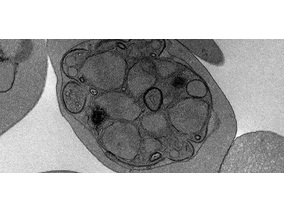
Targeting a key metabolic step in 'P. falciparum' offers hope for developing new treatments that don’t harm human cells
Read more
Recently, procedures have been established at the European level to facilitate the conduct of studies involving seasonal vaccines, enabling sponsors to initiate clinical trials in time to coincide wit...
Read more
Investigadoras del Área de Microbiología de la Universidad de Jaén (UJA) han identificado esporas bacterianas que presentan actividad antimicrobiana para luchar contra Xylella fastidiosa, fitopató...
Read more
La tesis doctoral de Sara María Cortés Lara desarrolla una herramienta que anticipa la resistencia bacteriana y podría revolucionar el tratamiento de infecciones hospitalarias
Read more
Concluyen que aunque no existen diferencias significativas en el número de pacientes que mejoraron el daño pulmonar provocado por un síndrome de dificultad respiratoria aguda inducido por Covid-19 ...
Read more
Se ha demostrado que la reactivación del citomegalovirus (CMV) tras un trasplante hepático podría asociarse con una menor recurrencia del carcinoma hepatocelular (HCC), el tipo más común de cánc...
Read more
El estudio revela que este serotipo se ha convertido en una de las principales causas de enfermedad neumocócica invasiva en España, tanto en adultos como en población pediátrica. El aumento se deb...
Read more
AIDA (An Artificially Intelligent Diagnostic Assistant for gastric inflammation) es una iniciativa europea de investigación e innovación financiada por la Unión Europea que busca transformar el abo...
Read more
The U.S. Food and Drug Administration (FDA) has granted orphan drug designation to a new gene therapy for Amyotrophic Lateral Sclerosis (ALS) developed at the Universitat Autònoma de Barcelona and li...
Read more
The deeptech company DevsHealth, a member of Catalonia.health, and the Foundation for the Research of Neglected Diseases (FNDR), based in India, announce the identification of DHFLV_003B, the first an...
Read more
The research, published in the journal Nature Communications, identifies an area of the abdomen as a hiding place for the bacteria, which could explain why the disease becomes chronic.
Read more
The study shows that resistant strains persist despite conjugate vaccines and warns of worse outcomes in people with a poor prognosis treated with amoxicillin.
Read more
La mejor actitud que podemos adoptar es la de trat...

The research team observed changes in head circumf...

AtCDF3 gene induced greater production of sugars a...

En nuestro post hablamos sobre este interesante tipo de célula del...

Telum Therapeutics, a biotechnology company leveraging proprietary met...